






Quick Answer: A motivation letter for university is a 500-800 word personal essay explaining why you want this specific program at this specific university, your academic journey, and career goals. Structure: (1) Hook opening – specific moment, not generic statement; (2) Academic background – relevant coursework, projects, research; (3) Why this program and university – name specific faculty, courses, or features; (4) Career goals – short and long term; (5) Confident close. Most important section: ‘Why this program at this specific university’ – generic letters that could apply anywhere are immediately identified and deprioritized. Required by: Germany, Netherlands, France, Scandinavia (called ‘Motivation Letter’); USA/UK/Canada call the same document SOP or Statement of Purpose.
When you apply to a university abroad, your grades and test scores tell one part of your story. Your motivation letter tells the part they cannot.
It explains why you want this specific program, what has shaped your academic journey, and what you plan to do after you graduate. Done well, it is the most personal and persuasive document in your application. Done poorly, it is immediately forgettable.
This guide covers exactly what a motivation letter for university is, how it differs from an SOP and a cover letter, how to structure it, and what a strong one looks like.
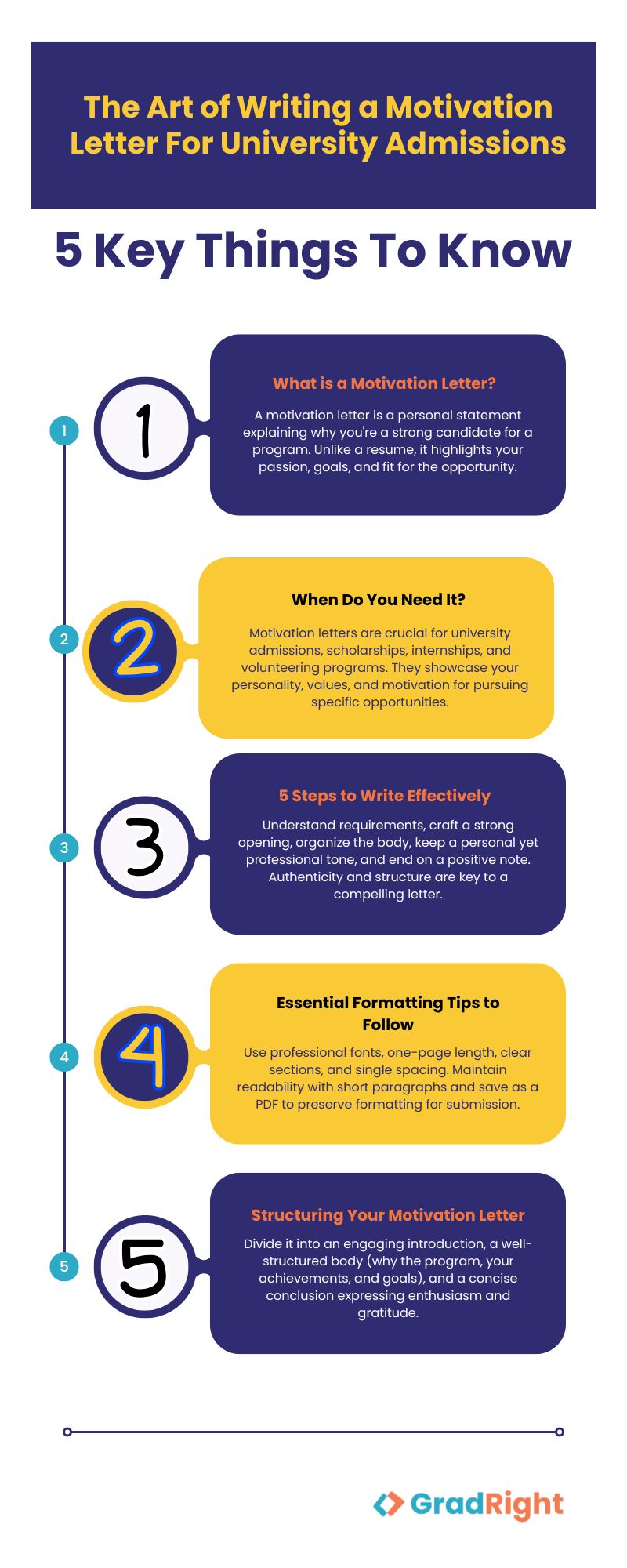
Motivation Letter for University – Quick Reference
| Question | Answer |
| What is a motivation letter for university? | A personal essay (500-800 words) explaining why you want to study this specific program at this specific university, your academic journey, and your career goals. |
| Is it the same as an SOP? | Often used interchangeably. Motivation letters are more common in European universities (Germany, Netherlands, France) while SOP is the standard US/UK term. Both serve the same purpose. |
| Is it the same as a cover letter? | No. A cover letter is for job applications. A motivation letter is for university admissions. |
| How long should it be? | 500-800 words for most programs. Some universities specify their own limit – always check first. |
| What is the most important section? | Why this program at this specific university. Generic motivation letters that could apply anywhere are immediately recognized and deprioritized. |
| When is it required? | Germany, Netherlands, France, Scandinavia, Eastern Europe. US/UK/Canada call the same document an SOP or personal statement. |
What is a Motivation Letter for University?
A motivation letter for university is a personal essay that explains your reasons for applying to a specific program. It goes beyond your transcript and resume to show the admissions committee who you are, what drives you academically, and why you are a good fit for their program.
The term is used most commonly in European university applications – Germany, Netherlands, France, Scandinavia, and Eastern Europe. In the USA, UK, and Canada, the same document is typically called a Statement of Purpose (SOP) or personal statement. Functionally, they are the same thing.
Your motivation letter is your chance to speak directly to the admissions team – not through numbers or titles, but through your story and your reasoning.
Also Read: Statement of Purpose (SOP) – All You Need to Know
Motivation Letter vs SOP vs Cover Letter – What is the Difference?
| Document | Used For | Primary Focus | Typical Length |
| Motivation Letter | University admissions (especially European universities) | Why this program, academic journey, career goals, personal motivation | 500-800 words |
| Statement of Purpose (SOP) | University admissions (USA, UK, Canada, Australia) | Same as motivation letter – academic background, goals, program fit | 800-1,200 words |
| Personal Statement | UK undergraduate (UCAS), some postgraduate programs | Academic interest in subject, preparation, extracurriculars | 4,000 characters (UCAS) or 500-700 words |
| Cover Letter | Job applications, internships | Professional experience, why this role, why this company | 250-400 words |
| Scholarship Motivation Letter | Scholarship applications | Academic merit, financial need if applicable, alignment with scholarship values | 400-700 words |
The practical difference between a motivation letter and an SOP is often just terminology. European universities ask for a ‘motivation letter.’ US and UK universities ask for an ‘SOP’ or ‘personal statement.’ Content expectations are very similar. Always check the specific university’s guidelines.
Motivation Letter Structure – Section by Section
| Section | What to Write | Word Count |
| 1. Opening – Hook | Start with a specific moment, experience, or question that connects you to this field. Not “I have always been interested in finance.” A real, personal moment the reader will remember. | 80-100 words |
| 2. Academic Background and Preparation | Your relevant academic journey – coursework, projects, research, or skills that have prepared you for this program. Focus only on what connects to the program. Select the most relevant, do not list everything. | 150-180 words |
| 3. Why This Program and University (MOST CRITICAL) | Specific reasons for this program at this university – a faculty member’s research, a specific course, a lab, or an industry connection. Generic praise is immediately noticed and deprioritized. This section must be different for every application. | 130-160 words |
| 4. Career Goals and How This Program Enables Them | Where you want to go after graduation and how this specific program is the bridge. Short-term and long-term goals. Specific enough to be credible – not so scripted it sounds generic. | 100-130 words |
| 5. Conclusion | A brief, confident close. Express genuine enthusiasm and tie together your past, this program, and your future in 2-3 sentences. | 50-70 words |
Total: 510-640 words. Expand with specific details about your projects or the program to reach 650-750 words. For German university applications especially, keep it tight and structured – 500-600 words is often preferred.
Need help starting your motivation letter? GradSOP generates a personalized draft for your program and university in minutes. Try GradSOP Free
Also Read: SOP for MS – How to Write, Format, Samples and Tips
How to Write a Strong Motivation Letter – Step by Step
| Step | Action | Why It Matters |
| 1 | Start with your “why” before you start writing. Why do you want this program specifically? Not the field in general – this program at this university. | If you cannot answer this clearly, your letter will be vague. The strongest motivation letters are written by students who have researched the program deeply. |
| 2 | Open with a specific moment, not a general statement. Example: “The first time I opened my father’s dusty accounting ledger as a curious 10-year-old” beats “I have always been fascinated by finance.” | Admissions committees read hundreds of letters. A specific, memorable opening sets your letter apart immediately. |
| 3 | Research the program thoroughly before writing the “why this university” section. Find a faculty member, specific course, research group, or industry connection that connects to your goals. Name it. | Generic praise (“your program is world-renowned”) wastes your most critical section. Specific, informed observations show genuine interest. |
| 4 | Write your career goals specifically. “I want to work in finance” is weak. “I want to build risk analytics systems for emerging market fixed income products” is specific and credible. | Vague goals make you sound unprepared. Specific goals make you sound ready for graduate-level work. |
| 5 | Cut everything that does not directly support your case. Read each sentence and ask: does this help the committee understand why I am right for this program? | Motivation letters are not autobiographies. Every sentence should earn its place. |
| 6 | Customize for every application. Opening, academic background, and goals can stay consistent. The “why this program” section must be rewritten for every university. | Admissions committees can recognize recycled letters. A tailored letter shows you are serious about their specific program. |
| 7 | Proofread carefully. Grammar errors and awkward phrasing signal carelessness, especially for programs where writing quality is valued. | For humanities, social sciences, and business programs especially, writing quality is itself an evaluation criterion. |
Sample Motivation Letter – MS Finance, Netherlands (University of Amsterdam)
Use this sample to understand structure and tone. Do not copy it – write your own with your specific experiences, university, and program details.
[SAMPLE – Motivation Letter, MSc Finance, University of Amsterdam]
The first time I tried to price an Indian corporate bond using a textbook discount rate model, the numbers came out completely wrong. The model assumed a smooth yield curve and liquid secondary markets. Neither existed for the security I was analyzing. That gap between theoretical finance and the messy reality of emerging market debt markets is what I want to spend my career working on – and it is why I am applying to the MSc Finance program at the University of Amsterdam.
I completed my B.Com (Hons) from Shri Ram College of Commerce, Delhi University, with 87%, specializing in financial markets and corporate finance. My academic record reflects consistent depth in quantitative and theoretical finance – I scored in the top 5% of my cohort in Financial Derivatives and Corporate Valuation. My thesis, ‘Credit Spreads in Indian Corporate Bonds: Liquidity Premium vs Credit Risk Decomposition,’ combined regression analysis on five years of NSE bond data with theoretical models from Campbell and Taksler (2003). This research convinced me that studying credit risk requires both strong quantitative methods and deep institutional knowledge of specific markets – exactly the combination the UvA MSc Finance curriculum is built around.
The MSc Finance at the University of Amsterdam is the right program for this direction for two specific reasons. First, Professor [Name]’s research on credit risk in illiquid markets directly addresses the problem I encountered in my thesis. Second, the program’s fintech and fixed income elective track is the only European MSc curriculum I have found that treats emerging market debt as a serious research area rather than an afterthought. The program’s close ties with ING, ABN AMRO, and Robeco also provide access to the institutional perspective that purely academic training cannot replicate.
After the MSc, I plan to join the fixed income research or risk desk at an investment bank or asset manager – ideally one with significant exposure to Indian and Southeast Asian debt markets. Within five to seven years, I want to lead a credit research function that builds the analytical frameworks practitioners need to properly price and hedge emerging market corporate bonds. The quantitative methods and European institutional exposure of the UvA MSc are the foundation I need.
I am genuinely excited about the intellectual environment at the University of Amsterdam and confident that the MSc Finance program will give me the rigorous training and the network to pursue this direction effectively. I look forward to contributing to the department’s research community.
[End of sample – approx. 410 words. Strong because: specific opening problem; thesis research with real sources named; specific program features cited; concrete career goals; confident close. Expand to 600-700 words with more academic detail.]
Also Read: Motivation Letter for Scholarship: How to Write a Winning Personal Statement
Motivation Letter Requirements by Country
| Country | Term Used | Tone | Key Emphasis | Length |
| Germany | Motivationsschreiben / Motivation Letter | Formal, structured, direct | Academic credentials, technical competence, specific reasons for Germany | 500-700 words |
| Netherlands | Motivation Letter | Analytical, research-aware | Academic fit, research interests, why this program specifically | 500-800 words |
| France | Lettre de Motivation | Professional, structured | Academic background, career goals, connection to French academic tradition | 500-700 words |
| Scandinavia (Sweden, Denmark, Norway) | Personal Letter / Motivation Letter | Clear, concise, honest | Academic preparation, research direction, why Scandinavia | 400-600 words |
| USA | Statement of Purpose (SOP) | Personal, narrative | Individual story, research interests, specific faculty, career goals | 800-1,200 words |
| UK | Personal Statement / Statement of Purpose | Academic, analytical | Subject knowledge, academic preparation, career connection | 500-1,000 words |
| Canada | Statement of Purpose / Letter of Intent | Balanced – academic + personal | Research, academic goals, why Canada | 700-1,000 words |
| Australia | Personal Statement / Statement of Purpose | Goal-oriented, professional | Career relevance, academic preparation, future contribution | 600-900 words |
Also Read: SOP for UK Universities: Format, Samples and Tips
Strong vs Weak Opening Lines – Examples
Your opening determines whether the committee keeps reading. Here are the differences that matter:
| Weak Opening | Why It Fails | Stronger Alternative |
| I am excited to apply for the MSc Finance program at… | Every letter starts this way. It contains no information. | Start with the problem, question, or experience that drove your interest in this field. |
| Finance has always been my passion since childhood. | Vague, unverifiable, and forgettable. | The first time I tried to price a corporate bond using a textbook model, the numbers were completely wrong. That gap is what I want to study. |
| The University of Amsterdam is a world-renowned institution… | Generic flattery that adds nothing. | Name a specific faculty member’s research or specific program feature that connects to your goals. |
| I have always wanted to study in Europe. | Tells the committee nothing about your academic fit or motivation. | Explain what specific intellectual or research direction European academia offers that you cannot access at home. |
| I graduated with a 9.1 CGPA from… | Leads with a number, not a story. Your transcript already has this. | Lead with why the number exists – what drove you to perform, what you were working toward. |
Motivation Letter Dos and Don’ts
| Do’s | Don’ts |
| Open with a specific, personal moment connected to the field | Use generic phrases like “I am excited to apply for…” |
| Name specific program features, courses, or faculty | Write “this university is excellent and well-known” |
| Be specific about career goals | Say “I want to work in finance and contribute to the field” |
| Keep it under 800 words unless specified otherwise | Pad the letter to fill space |
| Customize the university section for every application | Send the same letter to every university |
| Write in your own authentic voice | Submit AI-generated content without rewriting it in your voice |
| Proofread for grammar and clarity | Submit with spelling or punctuation errors |
| Show intellectual curiosity beyond just qualifications | List achievements without connecting them to your purpose |
| Address academic weaknesses briefly and move on | Leave gaps in your academic record unexplained |
| Use formal language appropriate to graduate admissions | Use slang, contractions, or overly casual tone |
Found your target universities? Compare programs and check your profile fit from 40,000+ options worldwide. Explore Universities on GradRight
Related Application Guides
Statement of Purpose – All You Need to Know
How to Write an SOP – Complete Guide
SOP for MS – Format, Sample and Tips
SOP for MBA – Format, Sample and Tips
Motivation Letter for Scholarship
SOP for UK Universities
GradSOP – Free AI SOP and Motivation Letter Tool
How to Write a Professional LOR
Study in Germany – Complete Guide
Education Loan for Study Abroad













 Australia
  Canada
  France
  Germany
  India
India  Ireland
  UAE
UAE  United Kingdom
  United States