






Quick Answer: SBI (Global Ed-Vantage) is better if your loan requirement exceeds Rs 40 lakh – SBI offers up to Rs 3 crore with collateral and up to Rs 50 lakh collateral-free for top universities. UBI is better if your loan need is Rs 40 lakh or below, you want a longer moratorium (course duration + 12 months vs SBI’s + 6 months), or you prefer flexible local branch handling. Both offer Section 80E tax deduction on interest paid. Interest rates 2026: SBI starts ~9-10%; UBI starts ~9.25-9.75%. Verify current rates at sbi.co.in and unionbankofindia.co.in before applying.
When you start comparing public sector banks for a study abroad education loan, SBI and UBI almost always end up on the shortlist. SBI education loan for abroad studies is backed by India’s largest lender with one of the biggest education loan portfolios in the country. Union Bank of India, while smaller than SBI, has steadily grown its overseas education lending.
As a GradRight advisor, this is easily one of the most common questions from students and parents. Instead of going by reputation or what someone else picked, here is how SBI vs UBI education loans really differ.
SBI vs UBI Education Loan: Quick Decision Guide
| Choose SBI (Global Ed-Vantage) If… | Choose UBI (Union Bank) If… |
| Your total loan need exceeds Rs 40 lakh | Your total loan need is Rs 40 lakh or below |
| You want maximum loan amount (up to Rs 3 crore with collateral) | You want a longer moratorium – course duration + 12 months (SBI gives only + 6 months) |
| You prefer a standardised, predictable process with online application | You prefer flexibility at your local branch and direct relationship with branch manager |
| You have strong collateral and a financially stable co-applicant | You need slightly more flexibility in collateral documentation at branch level |
| Your university is on SBI’s approved list for collateral-free Rs 50L loans | Your funding requirement is moderate and the branch is accessible to your family |
SBI vs UBI Education Loan: Full Comparison 2026
| Feature | SBI (Global Ed-Vantage) | Union Bank of India (UBI) |
| Max Loan Amount | Up to Rs 3.0 crore with collateral; Rs 50 lakh collateral-free for select top universities | Up to Rs 1.5 crore secured; approximately Rs 40 lakh unsecured |
| Interest Rates (2026) | Floating rate, benchmark-linked. Approx 9-10%+ depending on profile and collateral. 0.50% concession for female students. Verify at sbi.co.in | Floating rate, EBLR-linked. Approx 9.25-9.75%+ for secured loans. 0.50% concession for female students. Verify at unionbankofindia.co.in |
| Moratorium Period | Course duration + 6 months after completion | Course duration + 12 months after completion (more breathing room post-graduation) |
| Repayment Tenure | Up to 15 years after moratorium ends | Up to 15 years after moratorium ends |
| Collateral-Free Limit | Up to Rs 7.5 lakh without collateral; up to Rs 50 lakh collateral-free for select top university lists | Up to Rs 4 lakh without collateral; Rs 4-7.5 lakh may accept third-party guarantee at some branches |
| Co-Applicant Requirement | Yes – financially stable co-applicant (parent or guardian) mandatory | Yes – financially stable co-applicant mandatory; may also require term life insurance cover linked to loan |
| Loan Coverage | Tuition fees, living expenses, travel, visa costs, insurance, library and exam fees | Same coverage as SBI |
| Processing Time | Standardised process; online application available; typically faster for well-documented applications | Branch-centric application; processing time varies by branch; digital options improving |
| Application Mode | Online + branch (online preferred for faster processing; sbi.co.in) | Primarily branch-based; improving digital channels (unionbankofindia.co.in) |
| Section 80E Tax Benefit | Yes – interest paid on education loan deductible under Section 80E (Income Tax Act) | Yes – interest paid on education loan deductible under Section 80E |
| Prepayment Penalty | Usually none | Usually none (some cases may vary) |
| Female Student Concession | 0.50% interest rate reduction | 0.50% interest rate reduction |
All interest rates are indicative as of 2026 and subject to change based on RBI MCLR/EBLR movements and bank policy. Always verify current rates directly with the bank before applying. Source: sbi.co.in/web/personal-banking/loans/education-loans and unionbankofindia.co.in/english/education-loan.aspx
Also Read: Education Loans Without Co-Applicants 2026: Complete Guide
1. Loan Amount: SBI vs UBI
Under the Global Ed-Vantage scheme, SBI study abroad loans can go up to approximately Rs 3 crore depending on your university, course, and collateral. For select top universities, SBI also offers collateral-free loans up to about Rs 50 lakh. Anything beyond that usually needs property or other security.
Union Bank of India education loans abroad are available up to around Rs 1.5 crore with collateral. For unsecured loans, most students typically get up to about Rs 40 lakh.
If your total study abroad cost is on the higher side – for example, a 2-year MS at a top US private university can cost Rs 80 lakh to Rs 1.2 crore – SBI’s higher ceiling under Global Ed-Vantage loan feels more flexible.
2. Interest Rates: SBI vs UBI
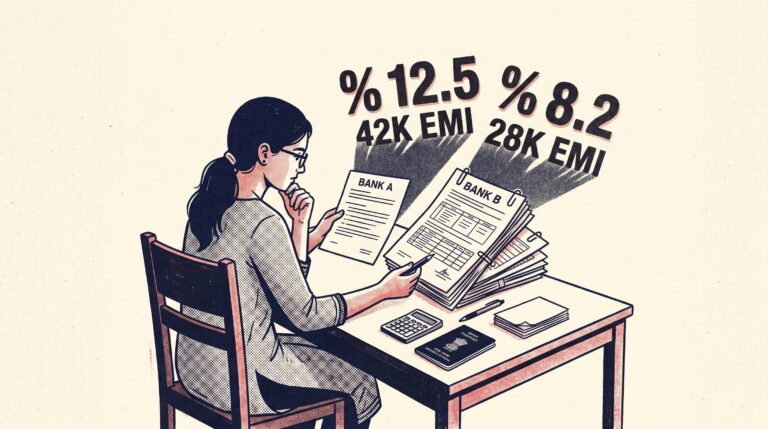
SBI education loan for abroad studies offers study abroad loans at floating interest rates linked to the external benchmark. The exact rate depends on your profile and collateral. Generally, rates start around 9-10% and adjust over time based on RBI rates and bank policy.
Union Bank of India education loan abroad rates are also linked to the External Benchmark Lending Rate (EBLR). The effective interest can range from around 9.25% to 9.75% for secured loans.
Advisor tip: Do not decide only based on the headline rate. The final rate you get depends on your co-applicant’s profile, the collateral you offer, and the scheme. A 0.25% difference in rate on Rs 50 lakh over 10 years is approximately Rs 1.5-2 lakh in extra interest – so get firm offers from both banks before deciding.
3. Collateral and Co-Applicant Requirements
With SBI, smaller loans up to about Rs 7.5 lakh often do not need collateral. Once you go above that, the bank usually asks for security like property, with a parent or guardian coming in as the co-borrower.
Union Bank of India works a bit differently. Loans up to Rs 4 lakh are typically collateral-free. Between Rs 4 lakh and Rs 7.5 lakh, some branches may accept a third-party guarantee instead of property. Above Rs 7.5 lakh, collateral is generally required, and under certain schemes, secured loans can go up to around Rs 1.5 crore. UBI may also ask for a life insurance cover linked to the loan.
In both cases, a financially stable co-applicant is a must. SBI’s collateral structure is usually more clearly defined, while UBI can be more flexible at the branch level if your paperwork is strong.
Also Read: Non-Collateral Education Loan for Study Abroad: How to Apply
4. Moratorium Period: UBI Has an Advantage
This is where UBI has a clear edge. SBI moratorium is course duration + 6 months after completion. UBI moratorium is course duration + 12 months after completion.
For most MS students abroad, the first 6-12 months after graduation are spent in job search (especially during OPT in the USA). An extra 6 months of moratorium means you do not need to start EMI repayment until you have a job and stable income. This is practically significant.
Both banks allow early repayment (prepayment) usually without penalty, so if you get a job earlier, you can start repaying sooner.
5. Section 80E Tax Benefit: Both Banks Qualify
Both SBI and UBI education loans qualify for the Section 80E tax deduction under the Income Tax Act, 1961. Under Section 80E, the interest paid on an education loan taken from a financial institution for higher studies is fully deductible from taxable income – with no upper limit.
This benefit applies for a maximum of 8 consecutive years from the year you start repaying the loan. It is applicable to loans taken for self, spouse, children, or a student for whom you are a legal guardian.
Note: Section 80E benefit applies only to education loans from banks and financial institutions (not from family members or employers). Both SBI and UBI qualify. (Source: Income Tax Act, 1961, Section 80E – incometax.gov.in)
Documents Required for SBI and UBI Education Loan
| Document Category | Common Documents Required (Both Banks) |
| Identity Proof | Aadhaar card, PAN card, Passport (for international students – passport is mandatory) |
| Address Proof | Aadhaar card, voter ID, driving license, utility bills (2 acceptable) |
| Academic Documents | 10th and 12th mark sheets; graduation mark sheets and certificates; entrance exam scores (GRE, GMAT, TOEFL, IELTS) |
| Admission Proof | Official admission letter from the foreign university confirming course, duration, and fees |
| Cost Estimate | Fee structure / cost sheet from university; living cost estimate; travel cost estimate |
| Co-Applicant Income Proof | Last 3 months salary slips; last 2 years ITR (Income Tax Returns); Form 16; bank statements (6 months) |
| Collateral Documents (if applicable) | Property ownership papers; latest property valuation certificate; encumbrance certificate; property tax receipts |
| Photographs | Passport-sized photographs of applicant and co-applicant |
| Bank Statements | Last 6 months bank statements of co-applicant |
| Additional (UBI) | UBI may additionally require term life insurance policy linked to the loan amount |
Note: Exact document requirements vary by branch and applicant profile. Contact your nearest SBI or UBI branch or check sbi.co.in and unionbankofindia.co.in for current document checklists.
Application Process: SBI vs UBI
| Step | SBI (Global Ed-Vantage) | Union Bank of India |
| Step 1 | Apply online at sbi.co.in or visit your nearest SBI branch with all documents | Visit your nearest Union Bank branch; digital application improving at unionbankofindia.co.in |
| Step 2 | Submit documents; SBI verifies admission letter, cost sheet, co-applicant income proof | Submit documents at branch; branch manager reviews your profile and collateral |
| Step 3 | Property valuation (if collateral required); co-applicant income verification | Branch credit team evaluates profile; may require branch visit from co-applicant |
| Step 4 | Loan sanction letter issued; review terms carefully before signing | Loan sanction letter issued; verify moratorium period (course duration + 12 months) |
| Step 5 | Disbursement directly to university (semester-wise in most cases) | Disbursement directly to university (semester-wise) |
Start your loan application at least 3-4 months before your program begins. Late applications often face disbursement delays that can affect visa processing and university deadlines.
Do not just apply to SBI or UBI alone. GradRight FundRight lets you receive competitive offers from 18+ lenders – including SBI, UBI, and private NBFCs – in 48 hours. Compare rates, moratorium terms, and processing speed. Students using GradRight get up to 40% better loan rates. Compare Loan Offers on GradRight
Also Read: Best Education Loan Providers in India 2026: Banks, NBFCs and Comparison
Who Should Choose SBI vs UBI: Advisor Verdict
SBI Global Ed-Vantage education loan might suit you better if:
- Your total expenses are high – for example, a top-tier US MS or MBA program costing Rs 80 lakh to Rs 1.2 crore total
- You want a structured, widely recognised education loan with predictable, standardised processing
- You have collateral ready (property valued at least 1.2-1.5x the loan amount) and a financially stable co-applicant
- You prefer to apply online and track your application digitally
Union Bank of India education loan abroad might suit you better if:
- Your funding requirement is moderate – Rs 25-40 lakh range
- You value a longer moratorium period – course duration + 12 months gives extra breathing room during your job search post-graduation
- You prefer a direct relationship with your local branch and face-to-face discussions
- Your branch is accessible to your co-applicant and the branch manager has discretion to offer flexibility on documentation
‘Risk comes from not knowing what you are doing.’ – Warren Buffett. With clear comparisons, you make informed, confident choices. An international education loan can have a lifelong impact on your finances. Do not depend on guesswork to choose your lender.
Related Guides
Best Education Loan Providers in India 2026: Banks, NBFCs and Comparison
Education Loans Without Co-Applicants 2026: Complete Guide
Non-Collateral Education Loan for Study Abroad
Education Loan Interest Rates Explained
Prodigy Finance vs Leap Finance: Which Is Better?
Education Loan Eligibility Criteria Guide for Indian Students
GradRight FundRight – Education Loan Platform












 Australia
  Canada
  France
  Germany
  India
India  Ireland
  UAE
UAE  United Kingdom
  United States