






If you’re an international student in the US on an F1 visa, or you’ve just moved to OPT, there’s a good chance you’re carrying an education loan back home in India, and paying a steep interest rate on it. Somewhere along the way, you’ve probably heard the term “refinancing” thrown around by seniors, LinkedIn posts, or student forums. But what is student loan refinancing, exactly, and does it actually apply to you at this stage of your journey?
This guide breaks it down: what student loan refinancing is, how it works, who it’s really built for, and what F1 and OPT students specifically need to know before they consider it.
What is student loan refinancing?
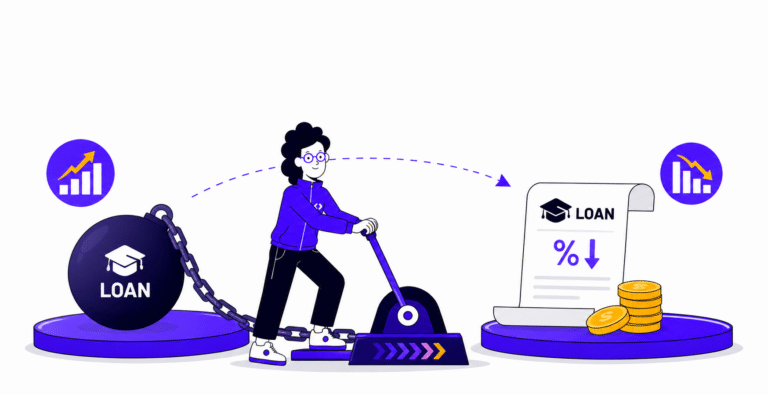
In the simplest terms, student loan refinancing means transferring your existing education loan to a new lender for a lower interest rate, better repayment terms, or a reduced EMI. Instead of continuing to pay your current bank or NBFC, a new lender pays off your old loan on your behalf, and you start repaying the new lender under fresh terms.
For Indian students specifically, refinancing usually means one of two things:
- Converting a rupee (INR) loan into a USD loan by refinancing with a US-based lender once you’re working in the country.
- Refinancing within India (INR to INR) by switching to a different Indian bank or NBFC that offers better rates.
The core idea in both cases is the same: you’re not taking on a new debt for a new purpose; you’re replacing an existing loan with a cheaper, better-structured one.
Why does student loan refinancing exist in the first place?
Education loans for studying abroad, especially from Indian lenders, typically carry interest rates that can run quite high compared to what’s available in developed economies. Once a student has completed their degree and stepped into steady employment, particularly in the US, a new financial picture opens up: local income, a local credit history starting to build, and access to lenders who serve people in exactly that position.
Refinancing exists to let students take advantage of that shift. The principal reason lenders can offer lower rates in a market like the US is that developed nations generally offer lower interest rates than developing nations. Beyond the interest savings, refinancing into a US loan also contributes to your credit score abroad, which can matter later when you want a home loan, an auto loan, or any other form of credit in your new country.
Who is student loan refinancing actually for?
This is where F1 and OPT students need to pay close attention, because refinancing isn’t equally available, or equally useful, at every stage.
The Ideal Candidate for Refinancing
The ideal candidate for refinancing is someone who has completed their education abroad and is about to enter employment, or has already started working. Career trajectory matters here too; lenders are essentially assessing your ability to repay based on your job stability and income, not just your degree.
Where F1 Students Fit In
If you’re still on an F1 visa and haven’t started working yet, refinancing generally isn’t something you’ll be eligible for in the traditional sense, since most refinance lenders want to see employment and income. That said, understanding how refinancing works while you’re still studying puts you ahead; you’ll know exactly what to look for and when to act the moment you transition to OPT or full-time work.
Where OPT Students Fit In
Once you move to OPT and start earning, you begin to resemble the profile lenders are looking for. This is also the point at which comparing lenders, understanding visa-specific eligibility, and watching for hidden costs becomes genuinely relevant to you. Certain lenders only cater to H-1B holders or permanent residents, while others are open to international students still on OPT, so your visa status will directly shape which lenders you can even consider.
How does student loan refinancing work?
Broadly, the mechanics look like this: a new lender pays off your old loan, and you begin repaying the new lender instead. As part of this, the new lender reassesses your credit profile, income, employment stability, and visa status before approving the new loan. When you refinance, you essentially take a new loan to pay off your current one, which results in fresh loan terms such as a lower interest rate, a longer or shorter tenure, and different terms around prepayment or foreclosure.
Here’s what the typical journey to refinance a loan looks like:
Step 1: Share Your Current Loan Details
You provide details of your existing loan – the amount outstanding, your current lender, and tenure. This is the information new lenders will use to assess what they can offer you.
Step 2: Compare Offers From Multiple Lenders
Rather than approaching one bank at a time, platforms built for refinancing let multiple lenders review your profile and put forward competing offers, so you can compare rates, EMIs, and total savings side by side instead of guessing or filling out separate applications everywhere.
Step 3: Apply for Prequalification
Once you’ve identified lenders worth pursuing, you apply for prequalification to get estimated rates without harming your credit.
Step 4: Submit Documents
You’ll need to share proof of employment, visa status, and your existing loan documents.
Step 5: Close the Old Loan, Start Fresh
The new lender repays your old loan in full, and you begin your repayment schedule under the new terms, starting to save from month one.
What to watch out for before you refinance
Refinancing can meaningfully reduce your loan burden, but it isn’t a decision to make on rate alone. A few things worth checking carefully:
Processing Fees and Penalties
Watch out for processing fees, prepayment penalties, or late payment charges. These can quietly make your “cheaper” loan more expensive than it looks on paper.
Flexibility During Tough Times
Life abroad is unpredictable; job changes, visa transitions, and unexpected expenses happen. Lenders offering deferment, forbearance, or flexible repayment plans during difficult periods are generally the safer picks.
Added Benefits
Some lenders offer extras like career support, networking opportunities, or discounts for setting up autopay. On their own these seem small, but they add up over the life of a loan.
Visa-Specific Eligibility
As mentioned earlier, not every lender serves every visa category. Confirming that a lender actually works with your current status, F1, OPT, or H-1B, before you invest time in an application will save you a lot of back-and-forth.
Two ways to refinance: INR to USD vs. INR to INR
Once you’re eligible, there are essentially two directions your refinancing can take:
INR to USD: This route lets you build credit in the US and cut your interest by a wide margin. It’s best suited for students who are working in the US and plan to stay abroad for the foreseeable future.
INR to INR: This route keeps your loan local and focuses on comparing India’s top lenders, rates, and benefits. It’s best suited for students who are returning to India or are primarily looking to secure lower EMIs without changing currency.
Which path makes sense for you depends largely on where your career and residency plans are headed, not just which rate looks lower today.
Benefits of refinancing your student loan
Pulling everything together, refinancing at the right time can offer:
- A lower interest rate compared to your original loan
- Smaller monthly EMIs
- A more flexible repayment tenure suited to your income stage
- Credit-building in your new country of residence
- The option to move from an unsecured to a secured refinance to cut costs further
How GradRight helps with refinancing
Comparing lenders manually, checking rates, fees, tenure, and flexibility one bank at a time, can get overwhelming fast, especially while you’re also settling into a new job or visa status. GradRight lets you enter your loan details once, see multiple refinance options side by side, and compare offers without repeatedly filling out applications or chasing different lenders.
Lenders bid for your profile, you compare offers, and once you choose, the new lender repays your old loan and you begin paying the new EMI. Plus, guidance through this process is offered at no consultancy fee to students. Reach out to us today!









 Australia
  Canada
  France
  Germany
  India
India  Ireland
  UAE
UAE  United Kingdom
  United States