






In 2026, Indian students have more options than ever. There are 70+ lenders competing for your education loan. But that also means more complexity in choosing the right one. On paper, most lenders look similar. All interest rates seem competitive. Terms sound reasonable. And everyone around you has a ‘best bank’ recommendation.
Just knowing which bank provides education loans in India is not enough. You need to pick the best education loan provider for your specific profile – your university, your course, your loan amount, your co-applicant situation. That is exactly what this guide fixes, so you can stop searching and start deciding.
Education Loan Providers in India 2026 – Quick Reference
Lender Type | Number Available | Interest Rate Range | Max Loan | Best For |
Public sector banks | 12 major public banks | 8.33% – 10.5% | Up to Rs 1.5 crore (secured) | Lowest rates, government subsidy eligibility, students with collateral |
Private sector banks | 21 private banks | 10% – 13% | Up to Rs 1 crore (ICICI) | Faster processing, higher unsecured limits, digital applications |
NBFCs | 9,500+ registered with RBI; top 6-8 for education | 10.5% – 14% | Up to Rs 1.5 crore (unsecured some) | Largest collateral-free amounts, fastest processing (3-7 days), flexible eligibility |
International lenders | Prodigy Finance, MPower Finance | ~12-14% APR (USD) | USD 220,000 (Prodigy) | No collateral, no Indian co-signer, no Indian CIBIL – for top global universities |
Total on GradRight FundRight | 18+ lenders | 8.33%+ | Compare all | All categories in one place, competing offers in 2 days |
Why 70+ Lenders Is More Problem Than Solution
India’s banking sector is vast. Students have compelling products from 12 public and 21 private banks. Public banks like SBI, Bank of Baroda, Bank of India, Union Bank, and Canara Bank have been the backbone for many students dreaming of studying abroad. Private banks such as ICICI, HDFC, Axis Bank, Yes Bank, and IDFC First also offer competitive products.
India also has 12 small finance banks and 43 Regional Rural Banks (RRBs). Many of these banks offer study abroad loans. Students can also get offers from NBFCs – there are over 9,500 NBFCs registered with the Reserve Bank of India, of which a focused subset specialize in education lending.
The result: over 70 lenders competing for your decision in 2026. But more options create more confusion, not more clarity. Most students end up applying to 2-3 banks they have heard of – and accepting whichever offer comes first, rather than the best available offer. This is the problem GradRight FundRight was built to solve.
Public Sector Banks – Lowest Rates, Government Subsidies
Public sector banks are where most Indian students start, and for good reason. The interest rates are the lowest available – starting around 8.33-8.40% for secured loans at SBI and Union Bank in 2026. The government backing also means your university will recognize the loan without hesitation.
Bank | Interest Rate (Abroad) | Max Secured Loan | Processing Fee | Key Advantage |
SBI (Global Ed-Vantage) | 8.40% – 10% | Rs 1.5 crore | Nil | Lowest rate, nil fee, CSIS/PM-Vidyalaxmi eligible |
Union Bank of India | 8.80% – 10.3% | Rs 1.5 crore | Nil | 650 CIBIL floor stated, specific eligibility criteria |
Bank of India (Star Education) | 8.40% – 10% | Rs 1.5 crore | Rs 10,000-20,000 (refundable) | Competitive rate, refundable fee |
Canara Bank (IBA Model) | 8.75% – 10.5% | Rs 1.5 crore | Confirm with branch | IBA scheme eligible |
Punjab National Bank (Udaan) | 8.35% (premium universities) | Rs 2 crore | 1%, max Rs 10,000 (refundable) | Rs 2 crore cap, premium university rate advantage |
Bank of Baroda | 8.70% – 10% | Rs 1.5 crore | Confirm with branch | Strong branch network |
IOB (Vidya Jyoti) | 9% – 12.55% | Rs 3 crore | Nil | Highest public bank cap Rs 3 crore, QS ranking concessions |
Public banks offer the lowest interest rates and are eligible for government interest subsidies (CSIS for family income below Rs 4.5 lakh, PM-Vidyalaxmi for income below Rs 8 lakh). The trade-off: processing takes 15-25 working days, the process is branch-heavy, and maximum collateral-free amounts are typically Rs 7.5 lakh (Rs 50 lakh at SBI for premier institutions).
Also Read: Compare Education Loan Interest Rates – All Lenders 2026
Private Sector Banks – Faster Processing, Higher Limits
Bank | Interest Rate (Abroad) | Max Unsecured | Key Advantage |
ICICI Bank | 10.25% – 13% | Up to Rs 1 crore (premier) | Highest private bank unsecured limit; cross-collateral with home loan; broader co-applicant eligibility |
IDFC First Bank | 11.75%+ | Up to Rs 1 crore | Digital-first, fast processing |
Yes Bank | 11.25% – 12.75% | Up to Rs 50 lakh | 4-tier interest rate system; multi-currency FOREX card |
Axis Bank | 10.5%+ | Varies | Strong branch network, competitive rates |
Federal Bank (Fed Scholars) | ~11.25%+ | Up to Rs 20 lakh | Nil processing fee for premier institutes; NRI/OCI eligible |
Kotak Mahindra Bank | 10.5% – 12% | Varies | Digital process; competitive for strong profiles |
Private banks offer faster processing (7-15 working days) than public banks and higher collateral-free limits. ICICI Bank stands out with up to Rs 1 crore collateral-free for premier institutions – the highest of any Indian bank. The trade-off: higher interest rates than public banks and no eligibility for government subsidies.
NBFCs – Built to Lend to Students
NBFCs were built to do one thing: lend to students. That singular focus matters. They approve loans in 5-7 working days instead of several weeks. They are more flexible about which universities they fund. They lend larger amounts without collateral than most banks will. The cost of this speed and flexibility is real – you will pay 1-3% more in interest. For students racing against visa or admission deadlines, that extra cost is often worth it.
NBFC | Interest Rate | Max Unsecured | Processing Fee | Key Differentiator |
HDFC Credila | 10.5% – 13% | Up to Rs 1 crore+ | 0.5 – 1% | Oldest education lender in India; universities know and trust them |
Avanse | 10.5% – 13% | Up to Rs 75 lakh | 1 – 2% | Broad university coverage, flexible eligibility |
InCred | 11% – 14% | Up to Rs 1.5 crore (website) | 0.75 – 1% | Higher stated unsecured limit, profile tiering |
Auxilo | 10.5% – 13% | Up to Rs 85 lakh (USA) | 1% + GST | 100% financing without confirmed admission, partial moratorium EMI for Masters |
Tata Capital | 11% – 13.5% | Up to Rs 85 lakh | 1 – 2% + taxes | Platinum/Gold university tier system; Tata brand trust; pre-admission sanction |
Prodigy Finance | ~12.15% APR (USD) | USD 220,000 | 4.2% admin fee | No collateral, no co-signer, no Indian CIBIL – for top global university admits |
HDFC Credila has been around longer than any other dedicated education loan provider in India. That history matters – especially internationally, where universities know and trust them. For students who prioritize lender reputation alongside rate and speed, Credila is a strong NBFC option.
Compare all 18+ lenders – public banks, private banks, NBFCs, and international lenders – in one place on GradRight. Compare Education Loans on GradRight
International Lenders – When Nothing Else Works
International lenders solve a very specific problem: they primarily serve students pursuing education abroad without collateral, without an Indian co-applicant, and without an Indian credit score. They assess you on your future earning potential rather than your family’s current financial situation. For students in that position, they are not just an option – they are often the only option.
Lender | Loan Currency | Max Loan | Co-signer Required? | Key Facts |
Prodigy Finance | USD | Up to USD 220,000 | No | No collateral, no Indian co-applicant. Eligible universities in top global rankings. ~12.15% APR. |
MPower Finance | USD | USD 100,000 | No | No collateral, no co-signer. Focuses on USA and Canada. Fixed rate. |
A real student described this moment: ‘I did not know I had an option to get a loan until I learnt of Prodigy from my financial adviser on GradRight… I thought I had zero options.’ The catch: international lender interest rates are meaningfully higher than Indian lenders, and repayment happens in foreign currency – introducing exchange rate risk if you return to India for work.
How to Choose Among Education Loan Providers in India
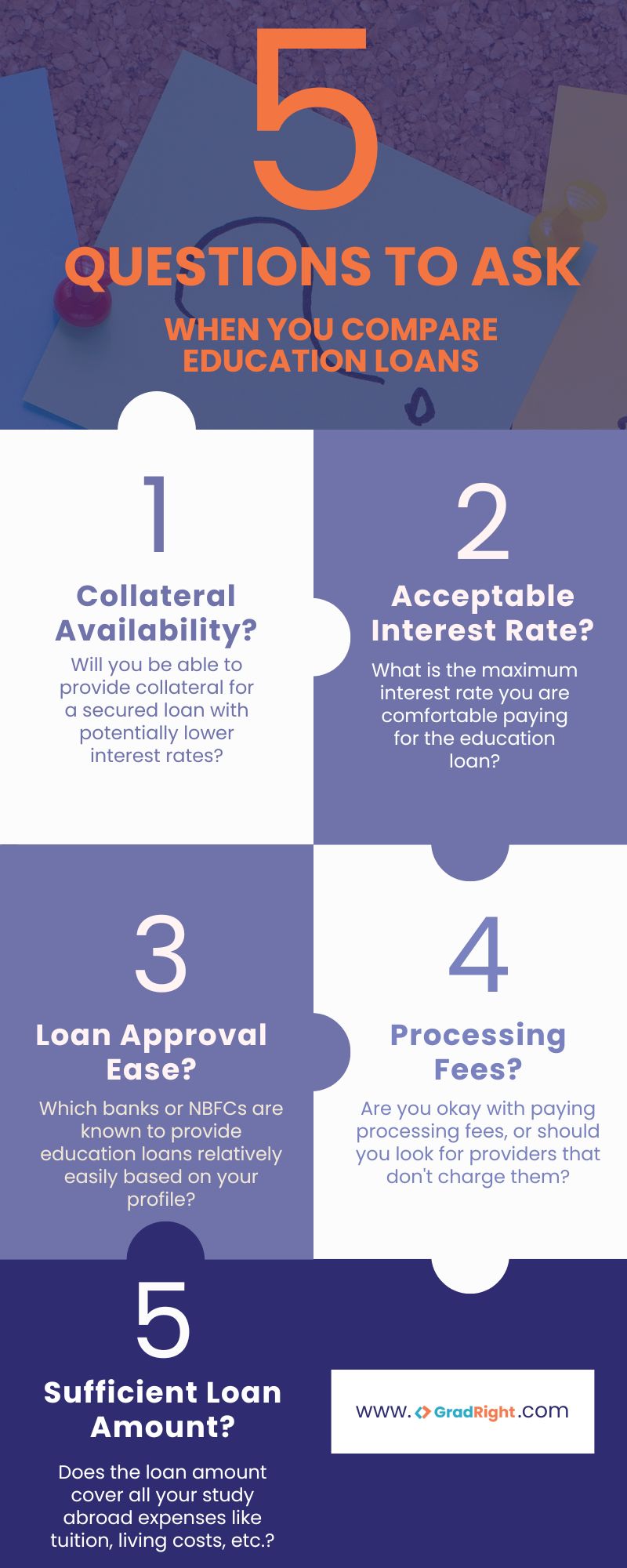
The best education loan provider in India is not a standard answer. It depends on what matters most to you. When comparing providers, question yourself on:
Question | What It Tells You |
Can I provide collateral? | Yes: public banks give you the best rates (8.33-10%). No: target NBFCs or ICICI Bank for higher unsecured limits. |
How quickly do I need the loan? | Urgent (visa/admission deadline): NBFC (3-7 days). Not urgent: public bank (15-25 days) for lower rate. |
Does my family qualify for CSIS/PM-Vidyalaxmi subsidies? | Income below Rs 4.5 lakh (CSIS) or Rs 8 lakh (PM-Vidyalaxmi): must use a public bank. Subsidies not available at private banks or NBFCs. |
What is my co-applicant CIBIL? | 700+: all options open. 650-700: NBFCs more flexible. Below 650: secured loan with collateral or NBFC with strong profile. |
How much do I need? | Below Rs 7.5 lakh: public bank collateral-free is fine. Rs 7.5L-75L unsecured: NBFC. Above Rs 75L: ICICI or secured public bank. |
Is my university recognized by the lender? | Check each lender list. Public banks generally recognize all accredited institutions. Some NBFCs (Tata Capital) only cover STEM/Management. |
Do I need a co-signer at all? | No co-applicant, no collateral: Prodigy Finance or MPower (international lenders) at top global universities. |
How GradRight FundRight Helps You Pick the Right Provider
Instead of the usual way where you apply to multiple lenders separately and hope for a good deal, GradRight flips the script. Here is how CEO Aman Singh describes it:
“A student comes on the platform and says: I have gotten admission from University X, I need X amount of money as a loan, here is where I studied, here is my GRE score, and so on. It is around 20-30 data points. The profile goes to our 15+ partner banks, and they see the profile and say, here is what I can offer – and they get to see each other bidding on the student.”
FundRight Feature | What It Means for You |
200,000+ students already on platform | Proven at scale. Lenders compete seriously for your profile because they know you have other options. |
18+ lenders bidding simultaneously | You see the best available rate, not just the first available rate. |
Competing offers in 2 days | Faster than visiting even one bank branch and waiting for a callback. |
FundRight expert at every stage | Guidance on comparing offers, understanding part-period interest, negotiating terms, and submitting documents correctly. |
1-1.5% rate reduction on average | Internal audits show the competitive model trims about 1-1.5 percentage points from the rate most families first hear at a bank counter. |
70%+ offers are unsecured | Over half the offers on FundRight require no collateral – access to up to Rs 50 lakh without pledging the family home. |
Over 200,000 students compared education loan providers in India on GradRight. Join them – free, no platform fee. Compare Education Loans on GradRight
What to Compare Across Education Loan Providers
Criterion | Why It Matters |
Interest rate | The most obvious factor. Even 1% difference on Rs 30 lakh over 10 years = Rs 3.5 lakh extra. |
Processing fees | Some lenders charge 1-2% upfront. On Rs 30 lakh, this is Rs 30,000-60,000. Public banks often charge nil. |
Maximum loan amount | Does the lender cover your full program cost? Shortfall means finding a second lender. |
Collateral requirement | Secured loans = lower rates but risk to family property. Unsecured = higher rates but no asset at risk. |
Processing speed | If your visa appointment is in 3 weeks, a bank with 4-week processing is not an option. |
Prepayment terms | SBI and ICICI: zero prepayment penalty. Some NBFCs: 2-5% penalty within certain years. |
Government subsidy eligibility | Only public banks qualify for CSIS and PM-Vidyalaxmi. Worth Rs 3-10 lakh in savings for eligible families. |
University and course coverage | Some lenders have restricted lists. Verify your specific institution is covered. |
Currency risk (international lenders) | USD-denominated loans carry exchange rate risk if you return to India before repaying. |
Also Read: Step-by-Step Guide to Securing an Education Loan for Studying Abroad
Related Education Loan Guides
Compare Education Loan Interest Rates – All Lenders 2026
Step-by-Step Education Loan Guide for Study Abroad
Education Loan Without Collateral for Study Abroad
SBI Education Loan for Study Abroad
ICICI Bank Education Loan for Study Abroad
Education Loan Processing Time in India
Education Loan Refinancing












 Australia
  Canada
  France
  Germany
  India
India  Ireland
  UAE
UAE  United Kingdom
  United States