






Quick Answer: MBA abroad is generally better for global careers – starting salaries $90,000-$120,000 vs Rs 10-50 lakhs in India. MBA in India is better for domestic careers – IIMs at Rs 24-27 lakhs total vs Harvard at $84,000/year tuition alone. Choose India if you want strong domestic networks and affordability; choose abroad if you want international exposure and global career access. Indra Nooyi (IIM Calcutta) proves Indian MBAs can go global too.
Good managers are essential for the success of a business. They provide leadership, set goals, and guide other employees toward achieving business objectives. A Master of Business Administration degree, or MBA, is the first step towards becoming a successful business manager.
But is it better to get an MBA degree in India or a degree abroad? Choosing between an MBA in India or abroad is a significant decision and one that can shape your future. In this article, we explore the differences between an MBA in India and an MBA from abroad to help you make an informed decision.
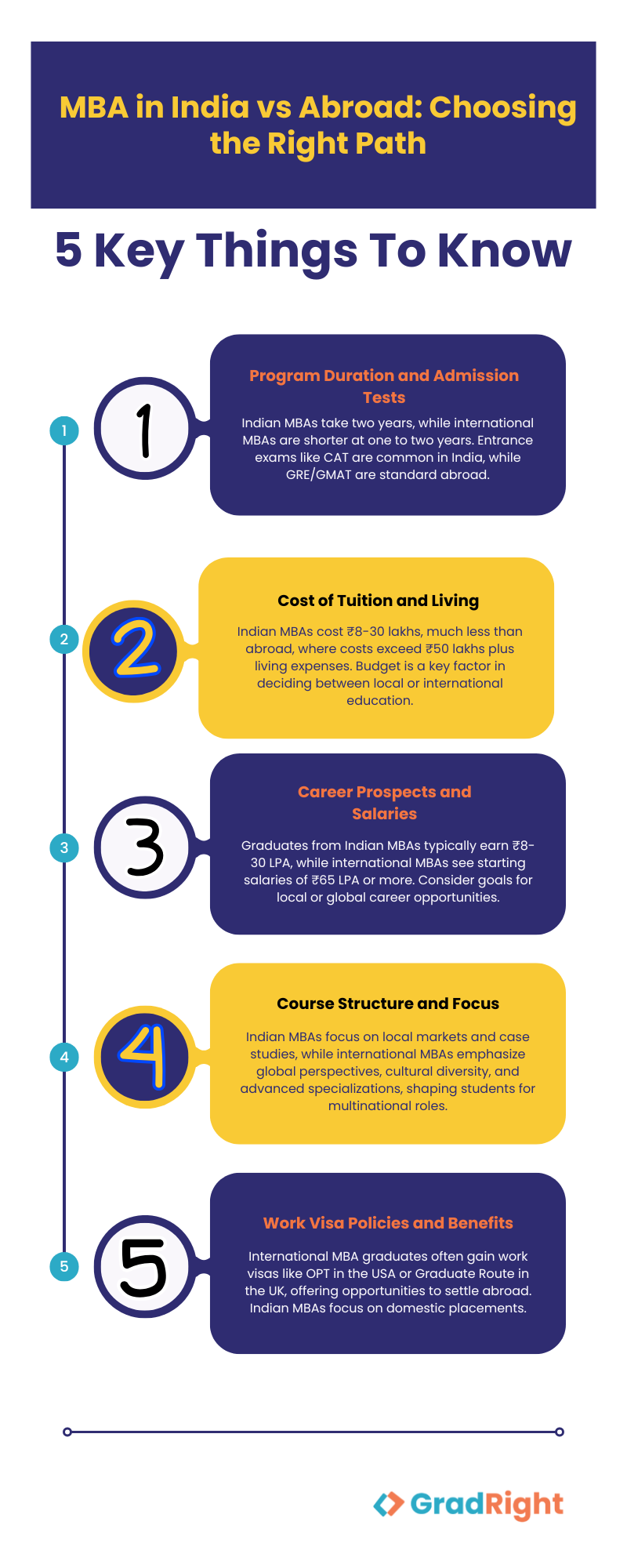
MBA in India vs MBA Abroad: Quick Decision Guide
| Choose MBA in India If… | Choose MBA Abroad If… |
| You plan to build your career primarily in India | You want to work for multinational companies or settle abroad |
| Cost is a major constraint – total Rs 8-27 lakhs vs Rs 50 lakhs to Rs 1 crore+ abroad | You have the budget or can secure an education loan for Rs 50 lakhs+ |
| You want strong domestic alumni networks (IIM, ISB) | You want access to global alumni networks across continents |
| You want to understand the Indian market deeply | You want exposure to global business practices and diverse cultures |
| You have 0-2 years work experience and want a full-time 2-year program | You have 2-5 years work experience and want a 1-2 year global program |
| You want CAT/XAT admission pathway | You have a GMAT score and want to apply to global rankings-based programs |
MBA in India vs MBA from Abroad: Key Differences 2026
| Factor | MBA in India | MBA from Abroad |
| Program Length | Generally 2 years | Typically 1-2 years (1 year common in UK/Europe) |
| Admission Tests | CAT, XAT, SNAP, NMAT, CMAT, IIFT, MAT, MAH-CET, IBSAT | GMAT or GRE + TOEFL or IELTS for language proficiency |
| Tuition Costs | Rs 6 lakh to Rs 30 lakh (total course) | Rs 50 lakh to Rs 1 crore+ per year at top schools |
| Living Costs | Around Rs 3 lakh per year | Approximately Rs 10 lakh per year |
| Starting Salary | Rs 8-50 lakh per annum | $80,000-$125,000 (~Rs 65 lakh to Rs 1.05 crore) |
| Education Approach | Focuses on regional Indian market industries and practices | Provides international exposure and advanced global specialisations |
| Job Prospects | Strong placements in domestic industries; top IIM grads get MNC placements | Access to global career opportunities and high-paying roles worldwide |
| Work Experience Required | Not mandatory at most B-schools (except Executive MBA) | Usually 2-5 years preferred by top global schools |
| Post-Study Work Rights | Domestic job market; IIM grads recruited by global consulting firms in India | Country-specific post-study work visas (OPT USA, Graduate Route UK, PGWP Canada etc.) |
| Cultural Exposure | Immersion in India’s business landscape | Interaction with diverse international business environments and peer cohorts |
MBA in India vs MBA from Abroad: Cost of Studying 2026
When comparing the cost of an MBA, studying in India is significantly cheaper than pursuing an MBA abroad. Top Indian B-schools like IIMs charge around Rs 20-27 lakhs total, while a foreign MBA can cost upwards of Rs 50 lakhs and even exceed Rs 1 crore, depending on the institution and country.
MBA Cost in India
| Type of Institution | MBA Fees (Rs) |
| IIMs (Ahmedabad, Bangalore, Calcutta) | Rs 24 lakh to Rs 27 lakh (total course) |
| IIMs (Newer – Bodh Gaya, Sirmaur etc.) | Rs 17 lakh to Rs 21 lakh (total course) |
| Mid-Tier Colleges | Rs 6 lakh to Rs 15 lakh (total course) |
| Public Universities | Rs 50,000 to Rs 4 lakh per annum |
| Private Colleges | Rs 8 lakh to Rs 20 lakh (total course) |
Note: These are total course fees, not including living expenses (~Rs 3 lakh/year in India).
MBA Cost Abroad: Top Universities 2026
| # | Institution | Country | Est. Annual Tuition (USD) | Est. Annual Tuition (Rs) |
| 1 | Stanford Graduate School of Business | USA | $84,000 | Rs 70.56 lakh |
| 2 | University of Pennsylvania (Wharton) | USA | $84,830 | Rs 71.26 lakh |
| 3 | Harvard Business School | USA | $84,900 | Rs 71.32 lakh |
| 4 | MIT Sloan School of Management | USA | $80,000 | Rs 67.20 lakh |
| 5 | Columbia Business School | USA | $84,000 | Rs 70.56 lakh |
| 6 | London Business School | UK | $70,000 | Rs 58.80 lakh |
| 7 | University of Cambridge (Judge) | UK | $66,000 | Rs 55.44 lakh |
| 8 | University of Oxford (Said) | UK | $66,000 | Rs 55.44 lakh |
| 9 | Melbourne Business School | Australia | $60,000 | Rs 50.40 lakh |
| 10 | AGSM (UNSW) | Australia | $55,000 | Rs 46.20 lakh |
Note: These are per-year tuition costs. Most foreign MBA courses last 18-24 months. Living costs and insurance are not included. INR conversion at approximately Rs 84/USD.
Also Read: Is an MBA Abroad Worth It Compared to an MBA in India?
MBA in India vs Abroad: Entrance Exams
Entrance Exams for MBA in India
| Exam | Conducted By | Frequency | Key Institutes Accepting Scores |
| CAT | IIMs (Indian Institutes of Management) | Annually | All IIMs and many top B-schools in India |
| XAT | XLRI (Xavier School of Management) | Annually (January) | XLRI, SP Jain, GIM, IIT-Madras DMS, Great Lakes, Loyola |
| MAT | AIMA (All India Management Association) | Four times a year | Christ University, Galgotias, MITCON, ITM Navi Mumbai, and others |
| SNAP | Symbiosis International University | Annually (December) | All Symbiosis Group of Institutions |
| NMAT | Narsee Monjee Institute of Management | October to December | NMIMS Mumbai/Bangalore/Hyderabad, ICFAI, Alliance University |
| CMAT | AICTE | Annually (April) | Jamnalal Bajaj, Great Lakes, Welingkar, Goa Institute of Management, BIMM |
| IIFT | Indian Institute of Foreign Trade | Annually (December) | IIFT Delhi, Kakinada, and Kolkata campuses |
| MH-CET | Government of Maharashtra | Annually (March) | Jamnalal Bajaj, KJ Somaiya, NL Dalmia, and Maharashtra MBA colleges |
| GMAT | GMAC (also accepted in India) | Year-round | ISB Hyderabad, some IIMs for PGPX (Executive MBA), and global B-schools |
Tests Required for MBA Abroad
| Test Type | Test Name | Purpose |
| Standardized Test | GMAT (Graduate Management Admission Test) | Required for admission to most global MBA programs; score range 200-800; 700+ for top schools |
| Standardized Test | GRE (Graduate Record Examinations) | Alternative to GMAT; accepted by most top global MBA programs now |
| English Proficiency | TOEFL (Test of English as a Foreign Language) | Required for non-native English speakers; most US/Australia programs accept |
| English Proficiency | IELTS (International English Language Testing System) | Commonly required by UK, Australia, Canada, and Europe programs |
| English Proficiency | PTE Academic (Pearson Test of English) | Accepted by various universities as English proficiency proof |
MBA Eligibility and Admission Requirements: India vs Abroad
| Requirement | MBA in India | MBA Abroad |
| Basic qualification | Bachelor’s degree (any discipline) | Bachelor’s degree (any discipline) |
| Entrance test | CAT/XAT/SNAP/NMAT etc. | GMAT or GRE |
| English proficiency | Not separately tested (CAT includes verbal) | TOEFL or IELTS required for most programs |
| Work experience | Not mandatory at most B-schools (except PGPX/Executive MBA) | 2-5 years usually preferred; some top programs require 3+ years average |
| GPA/Academic | Strong academic record preferred; no specific GPA cutoff | Usually 3.0+ GPA on 4.0 scale; top schools prefer 3.5+ |
| Interview/GD | Group Discussion (GD) and Personal Interview (PI) rounds | Essays, recommendations, and interviews; no GD in most foreign schools |
Also Read: MBA in Netherlands 2026: Top Universities, Fees and Career Scope
MBA Course Structure: India vs Abroad
| Aspect | MBA in India | MBA Abroad |
| Curricula Focus | Primarily analyses Indian market – regulations, industry trends, emerging sectors. Strong for domestic economy careers. | Wider global lens – covers global business dynamics and diverse market scenarios across continents. |
| Teaching Methodology | Heavy reliance on theoretical concepts and case studies; strong quantitative focus. | Experiential learning – simulations, company visits, global internships; practical application emphasis. |
| Specialisation Variety | Core specialisations: Finance, Marketing, Operations, HR, Strategy, IT. | Broader range including Sustainability Management, Luxury Brand Management, Global Supply Chain, FinTech, Healthcare Management. |
| Cohort Diversity | Primarily Indian cohort; limited international student mix at most schools. | Highly diverse international cohort; peer learning from students across 50+ countries at top schools. |
| Industry Integration | Strong ties with Indian industry; domestic case studies and guest faculty. | Strong ties with global companies; international case studies, company visits, and global internship opportunities. |
Top B-Schools: India vs Abroad
Top B-Schools in India
| B-School | Location | Total MBA Cost | QS MBA Rank |
| IIM Ahmedabad (IIMA) | Ahmedabad, Gujarat | Rs 24-27 lakh | Top 100 globally |
| IIM Bangalore (IIMB) | Bengaluru, Karnataka | Rs 24-27 lakh | Top 100 globally |
| IIM Calcutta (IIMC) | Kolkata, West Bengal | Rs 24-27 lakh | Top 100 globally |
| ISB Hyderabad | Hyderabad, Telangana | Rs 40-45 lakh | Top 50 globally (FT ranking) |
| XLRI Jamshedpur | Jamshedpur, Jharkhand | Rs 25-28 lakh | Highly respected in India |
| FMS Delhi | Delhi | Rs 2-3 lakh (government fees) | Excellent ROI; highly competitive CAT cutoff |
Top B-Schools Abroad
| B-School | Location | Annual Tuition | QS MBA Rank 2026 |
| Harvard Business School | Boston, Massachusetts, USA | $84,900 | #1 globally |
| Stanford Graduate School of Business | Stanford, California, USA | $84,000 | #2 globally |
| Wharton School (University of Pennsylvania) | Philadelphia, Pennsylvania, USA | $84,830 | #3 globally |
| London Business School | Regent’s Park, London, UK | $70,000 | Top 5 globally |
| INSEAD | Fontainebleau, France / Singapore | EUR 95,000 total (1-year program) | Top 5 globally |
| MIT Sloan School of Management | Cambridge, Massachusetts, USA | $80,000 | Top 10 globally |
MBA Career Prospects and Salary: India vs Abroad
An MBA from a top-ranked international business school generally offers wider global career opportunities and higher salaries. For those who graduate from the top 10 global business schools, a starting salary of $100,000 is not an outlier.
| Career Factor | MBA in India | MBA Abroad |
| Starting salary range | Rs 10 lakh to Rs 50 lakh per annum (IIM graduates at top end) | $80,000 to $125,000 (~Rs 65 lakh to Rs 1.05 crore) per annum |
| Top recruiters | McKinsey India, BCG India, Bain India, Goldman Sachs India, Amazon India, Flipkart, Reliance, HDFC, Deloitte | McKinsey global, BCG global, Goldman Sachs, Morgan Stanley, Google, Apple, Amazon, consulting and PE firms globally |
| Global career access | Possible – IIM/ISB grads do get MNC placements in India and occasionally abroad. Indra Nooyi (PepsiCo CEO) is an IIM Calcutta alumnus. | Direct access to global job markets; post-study work visas in USA, UK, Canada, Australia, Germany provide pathway to stay and work |
| Domestic career access | Strongest domestic market networks; deep understanding of Indian business landscape valued by Indian companies | Foreign MBA valued by Indian MNCs and startups but may be seen as overqualified/overpriced for purely domestic roles |
| Entrepreneurship | Strong networks for India-focused startups; IIM alumni networks deep in Indian startup ecosystem | Global network useful for cross-border startups; some schools (Stanford, HBS) specifically strong for entrepreneurship |
Post-Study Work Visa Options if You Study MBA Abroad
If you study abroad and want to stay and work after graduation, here are the post-study work visa options:
| Country | Visa Type | Duration | Key Features |
| USA | Optional Practical Training (OPT) | Up to 12 months; 24-month STEM extension | Must secure employment in field of study; apply before graduation |
| UK | Graduate Route Visa | 2 years (3 years doctoral) | No prior job offer required; no minimum salary; flexible employment |
| Canada | Post-Graduation Work Permit (PGWP) | Up to 3 years | Must have completed 2+ years of study; apply before study permit expires |
| Australia | Temporary Graduate Visa (Subclass 485) | 2-4 years depending on degree | Must meet English proficiency; work, study, or travel allowed |
| Germany | 18-Month Residence Permit | 18 months | Job search permit; work any job to support yourself during search |
| New Zealand | Post-Study Work Visa | Up to 3 years | Duration depends on study program length and location |
Since an MBA graduate is a top-tier employee, it is not difficult for any global employer to sponsor you and place you in any country where they operate. Company-sponsored visas are the most common route for top MBA graduates working globally.
Pros and Cons: MBA in India vs MBA Abroad
Pros of MBA in India
| Pro | Detail |
| Lower cost | Total Rs 8-27 lakhs vs Rs 50 lakh to Rs 1 crore+ abroad. Strong ROI for domestic careers. |
| Strong domestic network | Access to large pool of Indian companies and established business connections within the Indian market. |
| High placement rates | Top Indian B-schools have excellent placement records with leading Indian companies and Indian subsidiaries of MNCs. |
| Relevant curriculum for India | Programs tailor curriculum to address specific challenges and trends within the Indian business landscape. |
| No relocation, no visa hassle | Study and work in your home country without language barriers or visa complexity. |
Cons of MBA in India
| Con | Detail |
| Limited global exposure | Less exposure to international business practices and diverse perspectives compared to overseas programs. |
| Highly competitive admissions | Gaining admission to top Indian B-schools (IIMs, ISB, XLRI) is extremely competitive – CAT has 300,000+ test-takers for limited seats. |
| Potential salary ceiling for global roles | Salaries in India are lower than those offered by MNCs to graduates from top international programs if your goal is overseas employment. |
Pros of MBA Abroad
| Pro | Detail |
| Global alumni network | Access to a wider network of international alumni and business contacts across different industries and continents. |
| Diverse perspectives | Exposure to different cultures and business practices from around the world, enhancing global understanding and cultural intelligence. |
| Higher earning potential | Graduates from top international B-schools command higher salaries – starting $90,000-$125,000 at top schools. |
| Cutting-edge curriculum | International programs offer specialised and innovative courses with a focus on emerging trends and global business challenges. |
| Post-study work pathways | Country-specific post-study work visas provide legitimate pathways to work and eventually immigrate in most developed economies. |
Cons of MBA Abroad
| Con | Detail |
| High cost | Tuition fees and living expenses abroad are far higher – Rs 50 lakh to Rs 1 crore+ total investment. |
| Visa challenges | Obtaining a study visa and navigating immigration processes can be complex and time-consuming for Indian students. |
| Competition for jobs abroad | Securing a job abroad can be challenging depending on your specialisation, market conditions, and OPT/work permit timelines. |
| Currency risk for loans | Education loans taken in USD carry currency risk – if the rupee weakens, your EMI cost in INR rises. |
MBA in India or MBA from Abroad: Which One Is Right for You?
Choosing between an MBA in India and an MBA abroad depends largely on your career aspirations.
If you aim for a global career with multinational companies, an MBA abroad is preferable due to the wider exposure and international network it provides. If you plan to work primarily within the Indian market and value strong local connections and understanding of the domestic business landscape, an MBA in India might be the better choice.
But an MBA from India does not mean you will be stuck in Bangalore or Pune. Many IIM graduates work for global consultants such as McKinsey, BCG, and Bain and Company. Indra Nooyi, the legendary CEO of PepsiCo who retired in 2018, is an alumnus of IIM Calcutta. If you want to settle abroad and work there, it is better to pursue an MBA degree from abroad.
GradRight uses data-driven approach to create a curated shortlist of the best global and Indian business schools perfectly suited for your profile, budget, and career aspirations. 8 million+ data points. Free. Find Your Best MBA Program on GradRight
Also Read: Top Universities by Employability 2026
MBA degrees are expensive. GradRight FundRight connects you with 18+ lenders who compete to offer the best education loan rates. Students using GradRight get up to 40% better loan rates. Apply on GradRight FundRight
Related Guides
Is an MBA Abroad Worth It Compared to an MBA in India?
MBA in Netherlands 2026: Top Universities, Fees and Career Scope
Top Universities by Employability 2026
Jobs After MBA in Australia 2026
Countries Offering Post-Study Work Visa 2026
Education Loan Eligibility Criteria Guide for Indian Students
GradRight SelectRight – University Selection Platform













 Australia
  Canada
  France
  Germany
  India
India  Ireland
  UAE
UAE  United Kingdom
  United States