




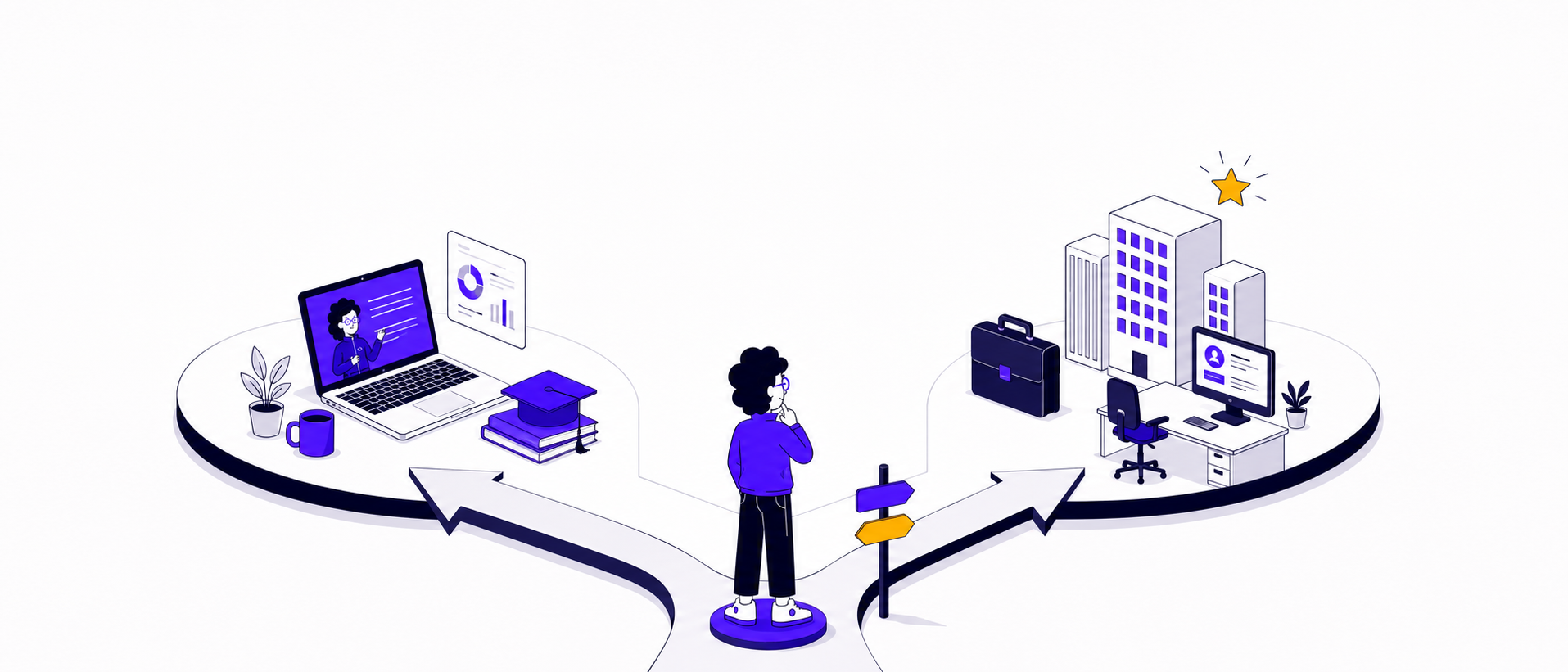
“Executive MBA” sounds like a more advanced, more impressive version of an online MBA, and many program pages lean into that impression deliberately. The reality is that Online MBA and Executive MBA are not a ladder where one is simply “better” than the other. They are designed for different career stages, and applying for the wrong one at the wrong stage is one of the more expensive mistakes in Indian management education.
The eligibility and cost gap is significant: a standard online MBA (NMIMS, Symbiosis, Amity, Chandigarh University) costs Rs 1.2-2.5 lakh and is open to fresh graduates with 0-6 years of experience. A traditional Executive MBA, particularly from IIMs or ISB, costs Rs 15-40 lakh and typically requires 5-15 years of experience, often with employer sponsorship.
The people asking this question span from fresh graduates wondering if they should “wait” for an EMBA, to senior professionals wondering if a standard online MBA is “beneath” their experience level. Both groups are usually overthinking it, the answer is determined almost entirely by years of experience and current role level.
Side-by-side: Online MBA vs Executive MBA
| Factor | Standard Online MBA | Executive MBA (Traditional, IIM/ISB-tier) |
| Typical work experience required | 0-6 years. Many programs (NMIMS, Symbiosis) require none. | 5-15 years, often with employer sponsorship. Most programs require minimum 3-5 years; many candidates have 8-10+ years. |
| Fee range (2026) | Rs 1,20,000 – 2,50,000 for full program | Rs 15,00,000 – 25,00,000 average. IIM/ISB tier can exceed Rs 40,00,000. |
| Duration | 2 years (4 semesters), part-time, fully online | 1-2 years. Often delivered as weekend blocks, modular sessions, or residential weeks. |
| Curriculum focus | Management fundamentals: marketing, finance, HR, operations, strategy basics. Designed to move you into management. | Advanced strategic leadership, organizational transformation, C-suite decision-making. Designed to prepare you to lead the organization. |
| Peer cohort | Diverse: working professionals across experience levels, industries, and career stages. | Senior professionals at a similar level (directors, VPs, senior managers). Peer network is a core part of the value. |
| Who typically attends | Fresh graduates, early-to-mid career professionals (0-6 years) seeking management entry or credential upgrade. | Senior managers, directors, VP-level professionals seeking a leadership upgrade, not a career pivot but a step up in strategic thinking. |
| Top providers (India) | NMIMS, Symbiosis SSODL, Amity, Chandigarh University, IGNOU, Manipal, LPU, Jain. | IIM Bangalore, IIM Ahmedabad (consistently top-charted per Product Leadership 2026), ISB, XLRI Senior Executive Programs, Institute of Product Leadership (for product management EMBA). |
Key Takeaways
- Experience level is the single biggest filter, more than ambition or budget: Per OnlineChitkarau’s 2026 guide, “fewer than 8 years of experience? An Executive MBA is likely not the right fit, either in terms of program requirements or what the curriculum is designed to deliver.” This is not a soft recommendation; most EMBA programs have hard eligibility minimums.
- The fee gap (Rs 1.2-2.5L vs Rs 15-40L) reflects different products, not different “quality tiers” of the same product: An online MBA is designed to build management fundamentals for those entering or early in management. An EMBA is designed to refine strategic leadership for those already leading. Paying Rs 15-40L for content designed for someone with 0-6 years of experience would not deliver proportional value, and conversely, a 2-year-experience candidate would not meet EMBA eligibility regardless of willingness to pay.
- There is a middle tier: online “executive” tracks at Rs 3.5-4 lakh: NMIMS MBA WX (Working Executive) at up to Rs 4,00,000 occupies a middle position, positioned for working professionals with more seniority than the standard NMIMS Online MBA audience, but at a fraction of IIM/ISB EMBA fees. This tier is often underexplored by both standard-MBA and traditional-EMBA seekers.
- True cost comparison must include opportunity cost, not just tuition: A full-time MBA requires a 2-year career pause without income. Both Online MBA and EMBA let you keep your job and salary throughout, this is a shared advantage of both formats over full-time programs, but the EMBA premium (Rs 15-40L) is still substantial even without an income gap.
- Employer sponsorship changes the calculus for EMBA significantly: At the Rs 15-40L price point, EMBA becomes “worth serious consideration” specifically when “8+ years of senior experience with employer sponsorship on the table” per Product Leadership 2026. Self-funding an EMBA at this price point is a different decision than employer-sponsored access.
Standard Online MBA: Who it is for
A standard online MBA (NMIMS, Symbiosis SSODL, Amity, Chandigarh University, and similar UGC-DEB entitled programs at Rs 1.2-2.5 lakh) is the right entry point if you are 0-6 years into your career. This includes fresh graduates with no work experience (NMIMS and several others explicitly do not require work experience), and early-to-mid career professionals seeking either a credential upgrade for promotion eligibility or a foundational management qualification to move from a technical/individual-contributor role into management.
The curriculum is designed to build management fundamentals: marketing, finance, HR, operations, and strategy basics, alongside whatever specialization you choose (Finance, Marketing, HR, Operations, Business Analytics, etc.). This is not a limitation; it is the correct design for someone who has not yet held significant management responsibility and needs the foundational toolkit.
Executive MBA: Who it is for
A traditional Executive MBA (IIM Bangalore and IIM Ahmedabad consistently top the charts per Product Leadership 2026, alongside ISB and XLRI senior programs) is designed for senior managers, directors, and VP-level professionals, typically 5-15 years of experience, who want a “leadership upgrade, not a career pivot, but a step up in strategic thinking and peer network” per Jaro Education 2026.
The curriculum assumes you already understand management fundamentals (you have been practicing them for years) and focuses instead on advanced strategic leadership, organizational transformation, and C-suite-level decision-making. The peer cohort, professionals at a similar senior level, is described as “a key part of the value” because the network itself operates at the level you are trying to reach.
At Rs 15-40 lakh, this is rarely a self-funded decision for most professionals without employer sponsorship being part of the conversation. For those with 8-10+ years of experience and senior roles where employers do sponsor such programs, EMBA is “worth serious consideration.” For those earlier in their career, even with strong ambition, the program is both financially disproportionate and mismatched, an EMBA does not teach the fundamentals a 2-3 year professional still needs.
The middle tier: Online executive programs
Between the standard online MBA (Rs 1.2-2.5L, 0-6 years experience) and traditional EMBA (Rs 15-40L, 8+ years, often IIM/ISB), there is a middle tier of “online executive” programs, NMIMS MBA WX (Working Executive) being the most commonly cited example at up to Rs 4,00,000.
These programs are positioned for working professionals with more seniority than typical online MBA candidates but without access to (or interest in) the Rs 15-40L EMBA tier. The curriculum often sits between the two: more advanced than a standard online MBA, but without the C-suite-specific focus or elite peer cohort of an IIM/ISB EMBA. For professionals with 4-8 years of experience who do not meet typical EMBA eligibility (or whose employer will not sponsor an IIM-tier program), this middle tier is worth exploring before defaulting to either extreme.
The bottom line
Online MBA and Executive MBA are not the same product at different price points; they are different products designed for different career stages. Standard online MBA (Rs 1.2-2.5L) is correctly designed for 0-6 years of experience and builds management fundamentals. Traditional Executive MBA (Rs 15-40L) is correctly designed for 8+ years of senior experience and builds advanced strategic leadership, typically with employer sponsorship as part of the equation.
If you are in the 3-7 year range and neither extreme fits cleanly, online executive tracks like NMIMS WX (Rs 3.5-4L) occupy a worthwhile middle ground.
Explore standard online MBA programs by fee, specialization, and accreditation on GradRight.












 Australia
  Canada
  France
  Germany
  India
India  Ireland
  UAE
UAE  United Kingdom
  United States