




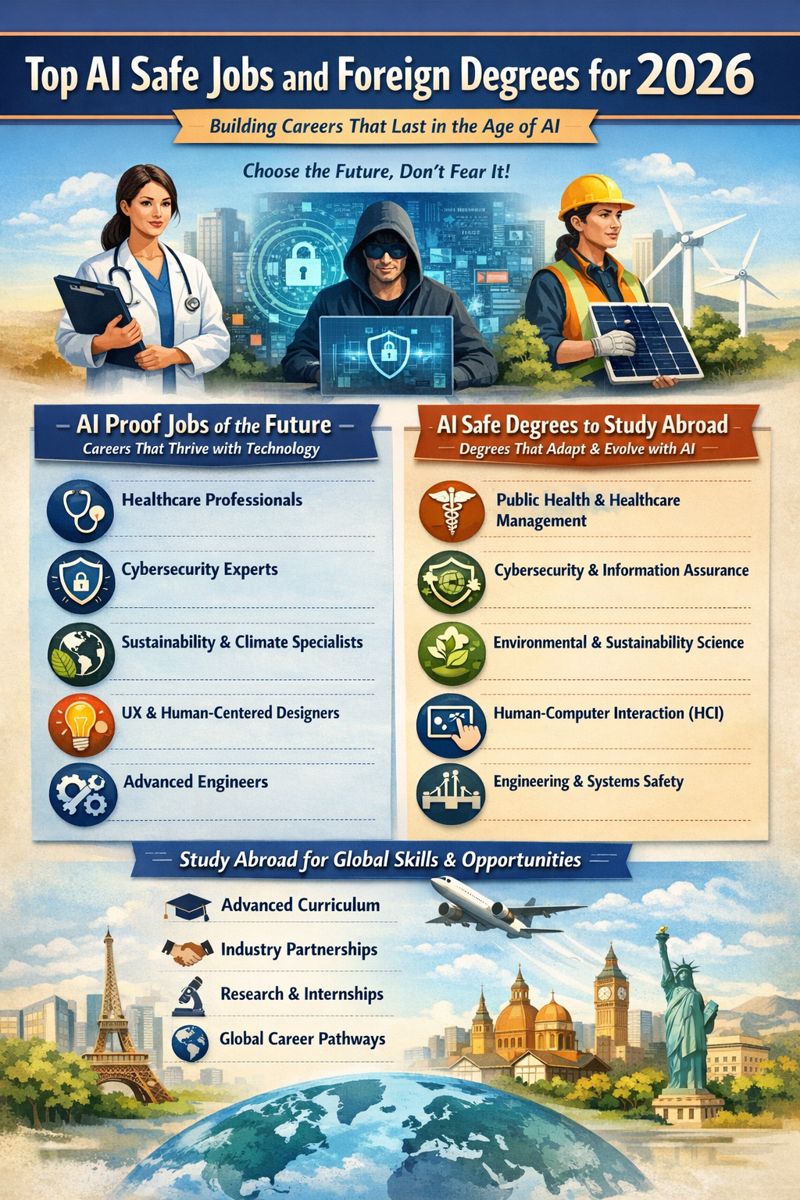

Quick Answer: AI-safe jobs 2026 are roles requiring human judgment, ethical accountability, and complex social interaction – all things AI cannot replicate reliably. Top AI-safe careers: (1) Cybersecurity/Penetration Testing – avg $112,000/year USA, 31% BLS growth; (2) Healthcare and Public Health – $80,000-$150,000+; aging populations drive 20-year growth; (3) Mental Health and Therapy – 0% automation risk (IDP/WillRobotsTakeMyJob); (4) Sustainability and Climate – ESG roles growing 40%+ globally; (5) Human-Centered Design and UX – AI generates designs, humans validate them; (6) Legal, Policy, and Governance – AI drafts, lawyers argue, judges decide. Most AI-safe foreign degrees 2026: Public Health, Cybersecurity, Environmental Management, HCI/UX, Systems Engineering, Clinical Psychology. Around 50 occupations show 0% AI automation risk (IDP AI-Safe Degrees Report 2026 – idp.com).
Artificial intelligence is no longer a future concept. It is already reshaping how companies hire, how work gets done, and how careers evolve. For students planning higher education abroad, this has created a new kind of anxiety.
The question is no longer just about salary or university rankings. It is about survival: will this job exist in ten years? Will this degree still matter? Will automation quietly reduce the value of years of study?
A 2025 analysis by IDP Education – drawn from 250,000+ courses and AI-risk modelling from WillRobotsTakeMyJob.com – found that the safest, best-paid, and most stable degrees abroad were overwhelmingly linked to healthcare, nursing, specialised medicine, social work, and therapy-based professions. Around 50 occupations currently show 0% risk of AI-driven automation. (Source: IDP AI-Safe Degrees to Study Abroad Report)
This guide breaks down the most AI-safe careers in 2026, the foreign degrees that lead to them, specific salary data, and the universities worth considering.
How AI Actually Affects Jobs: The Real Pattern
AI does not eliminate entire professions overnight. It eliminates tasks within professions. This distinction is critical for degree planning.
| Job Category | What AI Takes Over | What Remains Human | Net Effect on Jobs |
| Healthcare (doctors, nurses) | Diagnostic image reading; pattern recognition in scans; drug interaction checks | Clinical judgment; patient communication; ethical decision-making; emergency response | Net positive – AI assists, humans lead; 15-20% job growth projected |
| Legal (lawyers, judges) | Contract drafting; legal research; document review; precedent search | Courtroom argumentation; negotiation; judicial interpretation; client relationships | Task automation, not role elimination; lawyers using AI outperform those who don’t |
| Cybersecurity | Routine log analysis; basic threat detection; patch management automation | Adversarial thinking; novel attack response; policy design; ethical hacking | Net positive – AI creates new attack vectors requiring more human defenders |
| Data Analytics (generic) | Routine dashboards; standard reports; basic visualization | Domain interpretation; strategic recommendation; stakeholder communication | High risk if generic; low risk with domain expertise added |
| Software Engineering | Boilerplate code; standard testing; documentation | Architecture decisions; security design; complex debugging; system ownership | Shifts from execution to judgment; senior roles safer than junior execution |
| Mental Health and Therapy | Appointment scheduling; basic CBT apps for mild anxiety | Therapeutic relationship; crisis intervention; trauma processing; human empathy | 0% automation risk (IDP); demand growing with global mental health crisis |
| HR and People Management | Resume screening; payroll processing; scheduling | Culture building; conflict resolution; leadership development; ethics | Execution roles at risk; strategic HR roles growing |
Also Read: Top 10 Weirdest Jobs That Pay Well for Indian Students Abroad
Top AI-Safe Jobs 2026: Salaries, Growth and Why They Are Safe
| Career | Avg Salary USA (2026) | BLS Job Growth | AI Automation Risk | Why AI Cannot Replace This |
| Cybersecurity Analyst / Ethical Hacker | $112,000/year avg; senior $150,000-$200,000+ | 31% through 2029 (BLS) | Very Low | Adversarial thinking; novel threats; creative attack/defence strategies |
| Mental Health Counselor / Therapist | $60,000-$120,000/year | 22% through 2032 (BLS) | 0% (IDP report) | Therapeutic relationship; trauma processing; human empathy; crisis intervention |
| Registered Nurse / Clinical Nurse | $80,000-$120,000/year | 6-15% through 2032 (BLS) | Very Low | Physical patient care; real-time clinical judgment; ethical accountability |
| Sustainability Manager / ESG Analyst | $80,000-$130,000/year | 40%+ ESG role growth 2020-2026 | Low | Policy navigation; stakeholder negotiation; long-term systems thinking |
| Healthcare Administrator / Public Health Analyst | $75,000-$120,000/year | 28% for health services managers (BLS) | Low | Strategic planning; community health policy; multi-stakeholder coordination |
| UX Researcher / Human-Centered Designer | $90,000-$140,000/year | Strong; product design hiring growing | Low-Medium | AI generates options; humans validate cultural fit, emotion, and accessibility |
| Biomedical / Systems Engineer | $100,000-$140,000/year | 10% through 2032 (BLS) | Low | Safety-critical design; regulatory compliance; failure accountability |
| Social Worker / Community Health Worker | $55,000-$80,000/year | 9-11% through 2032 (BLS) | 0% (IDP report) | Complex human situations; advocacy; case-by-case judgment |
| Environmental Policy Analyst / Climate Consultant | $70,000-$110,000/year | Growing with ESG mandates globally | Low | Regulatory expertise; governmental navigation; long-term strategic planning |
| Legal Professionals (specialised areas) | $130,000-$250,000+ (lawyers) | Stable with specialisation premium | Low for specialists | Courtroom advocacy; judicial interpretation; negotiation; ethics |
Source: US Bureau of Labor Statistics (bls.gov) for growth projections and salary data. IDP Education AI-Safe Degrees Report (idp.com) for automation risk ratings. Salaries are US-based averages; UK/Canada/Australia figures vary.
Top AI-Safe Foreign Degrees 2026: What to Study and Where
Degrees that build judgment, ethical accountability, systems thinking, and human responsibility are the most AI-resistant. Here are the top AI-safe degrees for study abroad with specific universities and salary outcomes.
1. Public Health and Healthcare Management
| Detail | Information |
| Why AI-safe | Healthcare decision-making requires ethical judgment, patient communication, and community context. AI assists but cannot own clinical or policy outcomes. |
| Career outcomes | Public health analyst, healthcare administrator, clinical research manager, hospital operations director, global health consultant |
| Avg salary (USA) | $75,000-$120,000/year for MS-level graduates; MPH from top programs $90,000+ starting |
| Top universities abroad | Johns Hopkins Bloomberg School of Public Health (USA – #1 globally); Harvard T.H. Chan School of Public Health; London School of Hygiene and Tropical Medicine (UK); University of Melbourne (Australia) |
| IDP automation risk | Healthcare management: Very Low; Nursing: 0% for direct patient care roles |
| For Indian students | Strong PR pathways in Canada and Australia for healthcare administrators; UK NHS actively recruits international health workers |
2. Cybersecurity and Information Assurance
| Detail | Information |
| Why AI-safe | AI increases cyber threats – which directly increases demand for human defenders. Adversarial creative thinking cannot be automated. |
| Career outcomes | Penetration tester (ethical hacker), cybersecurity analyst, CISO, digital forensics specialist, cloud security architect, privacy officer |
| Avg salary (USA) | $112,000/year average (BLS 2025); senior roles $150,000-$200,000+; CISO $200,000-$400,000 |
| BLS job growth | 31% through 2029 – much faster than average |
| Top universities abroad | Carnegie Mellon (USA – #1 for cybersecurity globally); MIT; Georgia Tech; University of Edinburgh (UK); University of Melbourne (Australia) |
| Key certifications | OSCP, CEH, CISSP, CompTIA Security+ – stackable on top of MS degree |
| For Indian students | STEM OPT 36 months in USA; strong demand across USA, UK, Singapore, UAE, Australia |
Also Read: Top Engineering Universities in the World 2026: Rankings and Eligibility
3. Sustainability, Environmental Management and Climate Science
| Detail | Information |
| Why AI-safe | Climate policy requires negotiation, regulatory expertise, and long-term systems planning. AI models scenarios; humans make binding decisions. |
| Career outcomes | Sustainability manager, ESG analyst, climate risk consultant, environmental policy analyst, energy systems planner, carbon markets specialist |
| Avg salary (USA) | $70,000-$110,000/year; ESG analyst at financial institutions $90,000-$140,000 |
| Growth | ESG-related roles grew 40%+ globally between 2020-2026 driven by regulatory mandates (EU Taxonomy, SEC climate disclosure rules) |
| Top universities abroad | Yale School of the Environment (USA); ETH Zurich (Switzerland – #1 for environmental engineering); University of Edinburgh (UK); Australian National University |
| Why now | EU Corporate Sustainability Reporting Directive (CSRD) mandatory from 2025 creates massive demand for ESG professionals in Europe |
4. Human-Computer Interaction (HCI) and UX Research
| Detail | Information |
| Why AI-safe | AI generates design options; humans validate cultural fit, emotional response, accessibility, and ethical implications. UX research requires empathy. |
| Career outcomes | UX researcher, product designer, accessibility specialist, human factors engineer, design strategist, product manager |
| Avg salary (USA) | UX Designer: $110,000-$140,000/year at tech companies; UX researcher: $120,000-$150,000+ |
| Top universities abroad | Carnegie Mellon HCII (USA – best HCI program globally); Stanford d.school (Design); Georgia Tech; University College London (UK); Aalto University (Finland) |
| Growth | Every AI product needs human validation – HCI specialists are in demand at all major AI companies (Google, Microsoft, Meta, Apple) |
| For Indian students | STEM OPT eligible at most US programs; strong demand in Silicon Valley |
5. Clinical Psychology and Mental Health
| Detail | Information |
| Why AI-safe | IDP report identifies mental health counselling and social work as 0% automation risk. Therapeutic relationships require human presence, empathy, and accountability. |
| Career outcomes | Clinical psychologist, therapist, counsellor, psychiatric nurse practitioner, school counsellor, organizational psychologist |
| Avg salary (USA) | $80,000-$120,000/year; psychiatrists with MD $200,000-$300,000+ |
| BLS job growth | 22% for substance abuse counsellors and mental health counsellors through 2032 |
| Top universities abroad | University of Edinburgh (UK – strong clinical psychology); University of Melbourne (Australia); University of Toronto (Canada); Stanford (USA) |
| Global demand driver | WHO estimates 1 in 4 people globally affected by mental health conditions; post-pandemic surge in demand. Growing shortage of mental health professionals in all Western countries. |
6. Biomedical Engineering and Systems Engineering
| Detail | Information |
| Why AI-safe | Safety-critical engineering roles carry legal and regulatory accountability. Errors in biomedical or infrastructure systems have real-world consequences AI cannot own. |
| Career outcomes | Biomedical engineer, systems engineer, robotics engineer, infrastructure engineer, medical device designer, aerospace systems engineer |
| Avg salary (USA) | $100,000-$140,000/year for MS-level biomedical engineers; systems engineers $110,000-$150,000 |
| BLS job growth | 10% for biomedical engineers through 2032 |
| Top universities abroad | MIT (USA – biomedical engineering #1); Johns Hopkins; Imperial College London (UK); ETH Zurich (Switzerland); University of Toronto (Canada) |
| Why now | Medical device industry ($600 billion globally) and robotics ($80 billion) require human-accountable engineers at every design stage |
7. Law, Policy and Governance
| Detail | Information |
| Why AI-safe | AI can summarize contracts; it cannot argue before a court, interpret ambiguous law, mediate conflicts, or carry legal accountability for decisions. |
| Career outcomes | International lawyer, policy analyst, compliance officer, legal tech specialist, governance consultant, regulatory affairs manager |
| Avg salary (USA) | Lawyers: $130,000-$250,000+; Policy analysts: $70,000-$110,000 |
| Top universities abroad | Harvard Law School (USA); Yale Law; University of Oxford (UK – BCL/MJur); LSE (UK – law and policy); University of Melbourne (Australia – top law school in Asia-Pacific) |
| Growth area | AI governance, data privacy law (GDPR specialists), and international trade law are the fastest-growing legal specialisations globally |
| For Indian students | LLM (Master of Laws) from Oxford, LSE, or Harvard significantly boosts career trajectory for Indian lawyers going global |
Also Read: Average Salary in the USA for Indian Students After an MS
Which Degrees Are at Higher AI Automation Risk?
Not all degrees are equally safe. Degrees that train students primarily for execution – narrow, rule-based, repetitive tasks – face higher automation risk.
| Degree / Field | AI Risk Level | Why | What Saves It |
| Generic Data Analytics (without domain) | High | Dashboards, standard reports, basic ML are increasingly automated | Add domain expertise: healthcare analytics, financial risk analytics, climate modelling |
| Pure Coding / Software Development (junior) | Medium-High | Boilerplate code, unit tests, documentation being automated by GitHub Copilot, Claude, GPT-4 | Move to architecture, security, system design, AI engineering roles |
| Accounting and Bookkeeping | High | Routine transaction processing and basic tax filing heavily automated | Strategic advisory, forensic accounting, international tax remain safe |
| Translation / Language Services | High for standard content | AI translation (DeepL, GPT) handles standard content well | Specialised: legal translation, medical interpretation, cultural consulting remain safe |
| Paralegal / Legal Research (basic) | Medium-High | AI legal research tools (Harvey, Casetext) handle case research efficiently | Move to higher-judgment roles: client strategy, courtroom, negotiation |
| Business Analytics (generic MBA without specialisation) | Medium | General business operations being automated at junior levels | Specialise: healthcare MBA, tech MBA, ESG finance, AI product management |
Risk level does not mean the field is disappearing – it means the nature of work is changing. Students in these fields should add domain expertise, leadership training, or human-oversight capabilities to their degree.
How to Evaluate Whether Your Target Degree Is AI-Safe
| Question to Ask | What the Answer Tells You |
| Does this degree require human judgment that carries legal or ethical accountability? | If yes: likely AI-safe. Doctors, lawyers, clinical engineers, and licensed therapists bear responsibility AI systems cannot. |
| Is this degree primarily about execution, or about strategy and oversight? | Execution roles are automatable. Strategy, oversight, and judgment roles are not. Most degrees can be tilted one way or the other. |
| Does AI use in this field create more work for humans or reduce it? | Cybersecurity: AI creates more threats, needs more human defenders. Legal: AI tools make lawyers more efficient, not redundant. Identify which category your field falls into. |
| How does this field appear in IDP’s AI automation risk database? | IDP analyzed 250,000+ courses against WillRobotsTakeMyJob.com data. Healthcare, social work, and mental health show 0% risk. Check idp.com/ai-safe-degrees-to-study-abroad/. |
| Will this degree give me a post-study work visa that allows career exploration? | STEM OPT (USA, 36 months), UK Graduate Route (2 years), Canada PGWP (3 years), Australia Subclass 485 (2-4 years) all allow international students to transition careers post-graduation. |
GradRight SelectRight uses 8 million+ data points to match your academic profile with programs that offer AI-safe career outcomes, strong employment rates, and competitive salaries. Free. Find AI-Safe Programs on GradRight
Why Studying Abroad Specifically Helps with AI-Safe Careers
| Advantage | How It Helps |
| Access to programs not available in India | Clinical psychology, HCI, public health policy, cybersecurity governance programs at global research universities give curriculum depth unavailable domestically. |
| Post-study work authorization | F-1 OPT (USA), UK Graduate Route, PGWP (Canada), Subclass 485 (Australia) allow students to work in high-demand AI-safe fields after graduation and build local experience. |
| International employer networks | Working in the USA, UK, or Canada post-graduation gives access to global employer networks and career trajectories unavailable to graduates who return directly. |
| Research and industry partnerships | Top global universities have active industry partnerships in healthcare, cybersecurity, sustainability. Research experience during MS significantly improves career outcomes. |
| Credential recognition | An MPH from Johns Hopkins or MSc in Cybersecurity from Carnegie Mellon is recognized globally. Indian credentials in niche fields often face recognition barriers abroad. |
Also Read: Countries Offering Post-Study Work Visa 2026: Complete Guide
Verdict: Is Your Degree AI-Safe?
The AI revolution is not the end of your career. It is the beginning of a new kind of work. The students who will thrive are not those who avoid AI – they are those who choose degrees that position them above automation, not in competition with it.
Three questions determine AI-safety for any degree:
- Does it require human judgment that carries real accountability? (Healthcare, law, engineering safety, clinical psychology – yes)
- Does AI use in this field create more demand for humans or less? (Cybersecurity: more. Basic accounting: less.)
- Does the degree build adaptability – systems thinking, ethical reasoning, stakeholder management – or just execution skills?
Degrees that score well on all three are the most AI-safe investments for 2026 and beyond. The specific fields: Public Health, Cybersecurity, Mental Health and Social Work, Sustainability and Climate, HCI/UX Research, Biomedical and Systems Engineering, and specialised Legal/Policy programs.
The future belongs to those who plan for change, not those who fear it.
Find the right AI-safe MS program for your profile. GradRight evaluates 40,000+ programs by career outcomes, employment rates, and salary data. Free, AI-powered. Compare AI-Safe Programs on GradRight
Need funding for your AI-safe degree abroad? GradRight FundRight connects you with 18+ lenders competing for your loan in 48 hours. Apply for Education Loan on GradRight FundRight
Related Guides
Top 10 Weirdest Jobs That Pay Well for Indian Students Abroad
Average Salary in the USA for Indian Students After an MS
AI Proof Master’s Degrees That Will Still Pay in 2035
Countries Offering Post-Study Work Visa 2026: Complete Guide
Top Engineering Universities in the World 2026
Top Job Skills in Demand for the Global Job Market 2026
GradRight SelectRight – University Selection Platform











 Australia
  Canada
  France
  Germany
  India
India  Ireland
  UAE
UAE  United Kingdom
  United States