






Quick Answer: SGPA (Semester Grade Point Average) = Sum of (Credit Points x Grade Points) / Total Credits for one semester. Formula: SGPA = (Sum of [Credits x Grade Points]) / Total Credits. Example: 5 subjects, total weighted points 136.5, total credits 16 → SGPA = 136.5/16 = 8.53. SGPA to percentage: (SGPA x 10) – 7.5 (most common Indian university formula). SGPA to US 4.0 GPA: 9.0-10.0 SGPA = 3.7-4.0 GPA; 8.0-8.9 = 3.3-3.7; 7.0-7.9 = 3.0-3.3. Good SGPA for study abroad: 8.0+ is competitive; 9.0+ significantly improves scholarship chances.
Different institutions across the globe use different marking and grading schemes. This makes it hard for universities to compare students’ performance. An SGPA acts as a uniform standard of academic performance. With an SGPA you can accurately present your academic achievements to potential universities abroad.
Whether you are planning to apply to a university in the USA, UK, Canada, Germany, or Australia, understanding your SGPA – what it is, how it is calculated, and how to convert it – is an essential step in the application process.
SGPA – Key Facts at a Glance
Feature | Details |
Full form | SGPA: Semester Grade Point Average (also known as Sessional Grade Point Average) |
What it measures | A student academic performance in a single semester |
Evaluation timeframe | Calculated at the end of each individual academic semester |
Scale used in India | 1 to 10 scale (most Indian universities and technical institutes) |
Formula | SGPA = Sum of (Credit Points x Grade Points) divided by Total Credit Points |
First Class threshold | SGPA of 7.0 or above on a 10-point scale (may vary by institution) |
Competitive for study abroad | SGPA of 8.0 or above generally considered competitive for top programs |
Excellent (scholarship-level) | SGPA of 9.0 or above significantly enhances scholarship chances |
Difference from CGPA | SGPA = single semester performance; CGPA = average of all SGPAs across all semesters |
Also called | Semester GPA, SPI (Semester Performance Index) at some Indian universities |
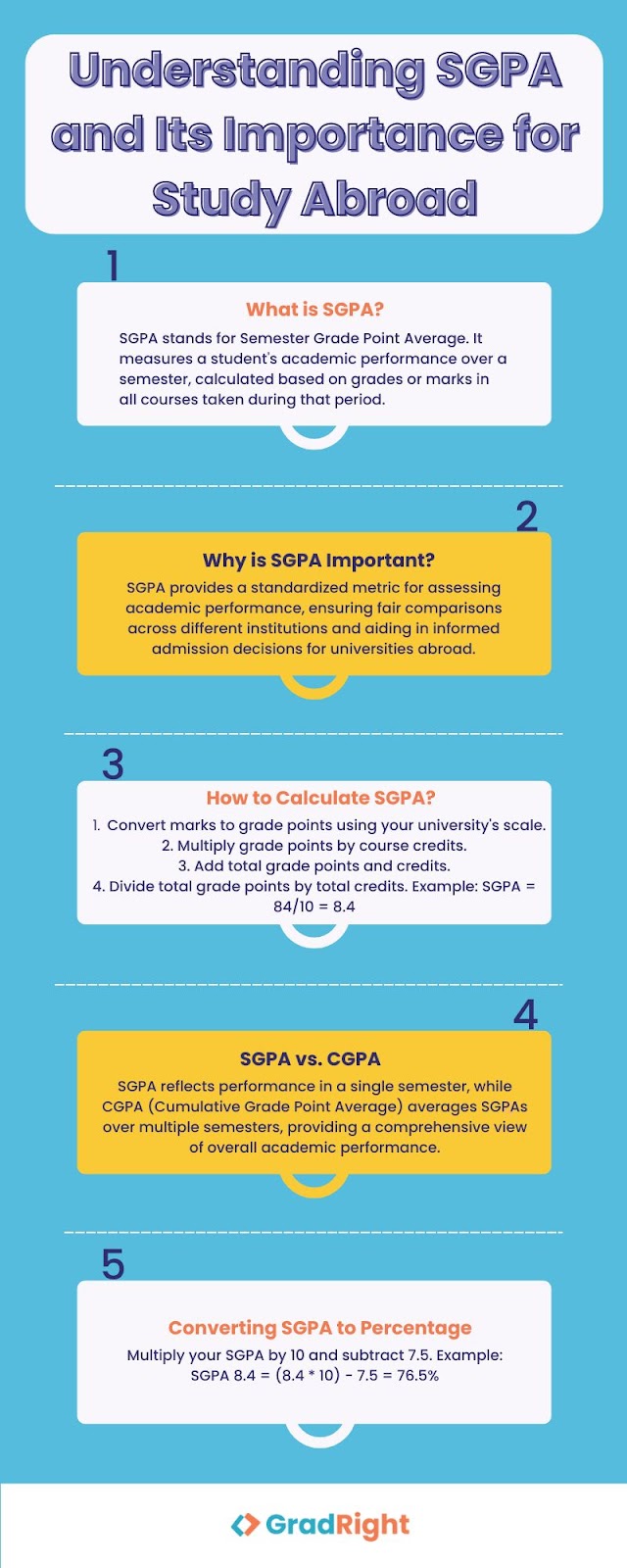
What is SGPA?
SGPA stands for Semester Grade Point Average. Sometimes, it is also known as a Sessional Grade Point Average. As the name suggests, SGPA is the measure of a student’s academic performance over a semester.
It is calculated based on the grades or marks that you score in all courses taken during a semester, weighted by the credit hours assigned to each course. SGPA is a weighted average that quantifies an individual student’s academic achievements over one single semester. Unlike a raw percentage system, it scales performance systematically, typically using a 10-point scale across prominent Indian educational boards and universities.
SGPA is important because it provides a standardised evaluation of academic grades across students from different educational systems. This helps in comparing candidate performance more fairly when universities assess international applications.
SGPA vs CGPA: What is the Difference?
Dimension | SGPA | CGPA |
Full form | Semester Grade Point Average | Cumulative Grade Point Average |
What it covers | Performance in ONE semester | Performance across ALL semesters (cumulative) |
How calculated | Sum(Credits x Grade Points) / Total Credits for one semester | Average of all SGPAs across all completed semesters |
When used | Reported at the end of each semester | Reported at the end of each academic year; shown on final degree certificate |
How they relate | CGPA is the average of all your SGPAs | Each semester SGPA feeds into the cumulative CGPA |
Which universities look at | Both; semester-wise SGPA shows consistency; CGPA shows overall performance | CGPA is most commonly requested in study abroad applications |
Example | SGPA of 8.5 in Semester 3 | CGPA of 8.2 across all 8 semesters |
SGPA (Semester Grade Point Average) reflects a student’s performance in a single semester. CGPA (Cumulative Grade Point Average) is an average of SGPAs over multiple semesters. So while SGPA measures performance in a specific semester, CGPA provides a comprehensive view of a student’s overall academic performance across all semesters.
How to Calculate SGPA: Formula and Step-by-Step Guide
The SGPA formula is:
SGPA = Sum of (Credit Points x Grade Points for each subject) / Total Credit Points for the semester
Step-by-step process:
Step | Action | Example |
Step 1 | List all subjects in the semester with their credit points (weightage assigned to each course) | Subject A: 4 credits; Subject B: 3 credits; Subject C: 4 credits; Subject D: 2 credits; Subject E: 3 credits |
Step 2 | Note the grade point earned in each subject (from your university grade point conversion chart) | Subject A: 9.0; Subject B: 8.0; Subject C: 8.5; Subject D: 7.0; Subject E: 9.5 |
Step 3 | Multiply credits x grade points for each subject | A: 4×9.0=36; B: 3×8.0=24; C: 4×8.5=34; D: 2×7.0=14; E: 3×9.5=28.5 |
Step 4 | Add all the multiplication results to get Total Weighted Grade Points | 36+24+34+14+28.5 = 136.5 |
Step 5 | Add all credit points to get Total Credits | 4+3+4+2+3 = 16 |
Step 6 | Divide Total Weighted Grade Points by Total Credits | SGPA = 136.5 / 16 = 8.53 |
In this example, the student’s SGPA for the semester is 8.53 on a 10-point scale. This is considered a strong academic performance and is competitive for most study abroad applications.
Another example from reference sources: if your total weighted grade point is 98 for 12 credits, your SGPA = 98/12 = 8.16.
Typical Indian University Grade to Grade Point Conversion
Letter Grade | Grade Points (10-point scale) | Percentage Range | Performance Level |
O (Outstanding) | 10 | 91-100% | Exceptional |
A+ (Excellent) | 9 | 81-90% | Excellent |
A (Very Good) | 8 | 71-80% | Very Good |
B+ (Good) | 7 | 61-70% | Good / First Class |
B (Above Average) | 6 | 56-60% | Above Average |
C (Average) | 5 | 51-55% | Average / Pass |
P (Pass) | 4 | 45-50% | Pass |
F (Fail) | 0 | Below 45% | Fail – requires re-examination |
Grade point conversions vary by institution. Always refer to your university’s official grade-to-point conversion chart before calculating your SGPA. First Class typically refers to an SGPA of 7.0 or above on a 10-point scale, indicating a high level of academic performance.
SGPA to Percentage Conversion
Two common formulas are used to convert SGPA to percentage:
Conversion Formula | Formula | Example | When to Use |
Formula 1 (most common for Indian universities) | Percentage = (SGPA x 10) – 7.5 | SGPA 8.5 = (8.5×10) – 7.5 = 77.5% | Used by VTU, Mumbai University, and many other Indian universities |
Formula 2 (simpler) | Percentage = SGPA x 10 | SGPA 8.5 = 8.5 x 10 = 85% | Some universities; verify with your institution |
Formula 3 (variation) | Percentage = (SGPA – 0.5) x 10 | SGPA 8.5 = (8.5-0.5) x 10 = 80% | Used by some institutions |
SGPA 10 (perfect) using Formula 1 | (10 x 10) – 7.5 = 92.5% | Perfect SGPA = 92.5% in this formula | Confirms that 10 SGPA does not equal 100% in this formula |
SGPA 6.5 using Formula 1 | (6.5 x 10) – 7.5 = 57.5% | 6.5 SGPA = approximately 57.5% | Pass level performance |
The most accurate conversion formula depends on your specific university. Always check your institution’s official SGPA to percentage conversion policy. When submitting applications to foreign universities, attach your official transcripts which will show the grading scale used by your institution.
SGPA to GPA Conversion (For US and International University Applications)
If you have completed your studies in India and plan to study abroad (particularly to the USA), you may need to convert your SGPA to the 4.0 GPA scale used by American universities.
Indian SGPA (10-point) | Approximate US GPA (4.0 scale) | Performance Level |
9.0 – 10.0 | 3.7 – 4.0 | Excellent / Dean List equivalent |
8.0 – 8.9 | 3.3 – 3.7 | Very Good / Competitive for top programs |
7.0 – 7.9 | 3.0 – 3.3 | Good / First Class; meets most program minimums |
6.0 – 6.9 | 2.7 – 3.0 | Average; meets basic admission requirements |
5.0 – 5.9 | 2.0 – 2.7 | Below average; may not meet minimum requirements at many programs |
Note: SGPA to GPA conversion is not standardised; different universities and credential evaluation agencies (like WES – World Education Services) may calculate equivalents slightly differently. Most top universities accept a 3.0 GPA (on a scale of 4.0) for admission. However, always check the eligibility requirements of your chosen university and program.
Why SGPA Matters for Your Study Abroad Application
How SGPA is Used | Details |
Admission eligibility check | Universities set minimum SGPA/GPA requirements for admission; your SGPA must meet these minimums to be considered. Some of the top universities in USA accept CGPA instead of SGPA – provide both on your application. |
Scholarship eligibility | Most universities consider an SGPA of 8.0 or above competitive for top programs; scores closer to 9.0 or higher significantly enhance chances of securing scholarships and financial aid |
Visa financial documentation | Many postgraduate work visa schemes (PGWP Canada, Subclass 485 Australia, F-1 USA STEM OPT) note your academic achievement; some STEM OPT extensions reference academic standing |
Employer assessment abroad | Employers abroad assess SGPA as a measure of academic consistency and discipline; submit attested mark sheets showing semester-wise SGPA for employer applications |
Program ranking and selectivity | For highly competitive programs (CS at CMU, EECS at UC Berkeley, Finance at LSE), a very high SGPA is often a prerequisite even to be considered in the shortlisting stage |
Improving your application overall | This helps improve your chances of admission to competitive programs abroad. Even if your overall CGPA is moderate, a strong final-year SGPA shows academic trajectory improvement |
Also Read: Best Colleges for MS in Computer Science Engineering
Tips to Improve Your SGPA for a Stronger Study Abroad Application
- Focus on core subjects in your discipline: admissions committees pay close attention to grades in subjects directly related to your intended program of study abroad
- Show an upward trajectory: if early semesters were poor, consistent improvement in later semesters demonstrates academic resilience and growth
- Take credits seriously: high-credit subjects have more impact on SGPA; prioritise performance in subjects with higher credit weightage
- Address weak semesters in your SOP: if you had a poor semester due to personal circumstances, address it directly and honestly in your Statement of Purpose
- Get strong LORs to compensate: faculty recommendations from professors who supervised you in your strongest work can compensate for a semester-level dip
GradRight uses 8 million+ data points to match your academic profile – including your SGPA – to the right programs and universities abroad. Free, personalised. Find Your Matching Programs on GradRight
Related Guides
Best Colleges for MS in Computer Science Engineering
Documents Required to Study Abroad
Top 10 Courses in Demand Abroad 2025-26
Education Loan Eligibility Criteria Guide for Indian Students
F1 Student Visa Rejection Reasons and How to Avoid Them
Is Taking a Rs 25-40 Lakh Education Loan Worth It?
GradRight SelectRight – University Selection Platform













 Australia
  Canada
  France
  Germany
  India
India  Ireland
  UAE
UAE  United Kingdom
  United States